
MACHEN STUDY No. 50
Selling the Angels
By the summer of 1915, the controversy surrounding Arthur Machen’s short story, “The Bowmen,”—published the previous September—had reached its zenith. Though the Legend of Mons was discussed across the British Press, the Evening News, Machen’s employer and original publisher of the story, certainly contributed to the rumor mill as it provided space for articles from many “experts.” The following short list is demonstrative. Nonconformist pastor Dr. R. F. Horton provided his views on the topic in an article entitled “Do Miracles Still Happen?,” published in the June 21, 1915 edition of the paper. The following month, an unsigned article reported on what an unnamed nurse heard. Three days later, on July 19th, an analysis by Helen de G. Verrell of the Society for Psychical Research made it onto the front page. The very next day, the Evening News chose to reprint the infamous tale.
During this time, Machen repeatedly joined the public discourse with criticism and refutations of the claims made by these various authors in the pages of his newspaper. Machen, who would later write of opposition as one of the zests and relishes of life, was temperamentally incapable of not responding, though it would probably have been better for his mental and emotional health had he not done so. All the while, the editorial board of the Evening News must have been pleased. After all, it sold papers.
And… it sold books.
As the number of articles and Machen’s responses increased during the spring and summer, a marketing campaign also grew in matching tempo. These factors would end in creating a best-selling book and its author’s greatest experience of fleeting fame. Below, we will explore this strategy using original sources, and although some pieces are missing, enough is available to present a clear picture for the modern reader.
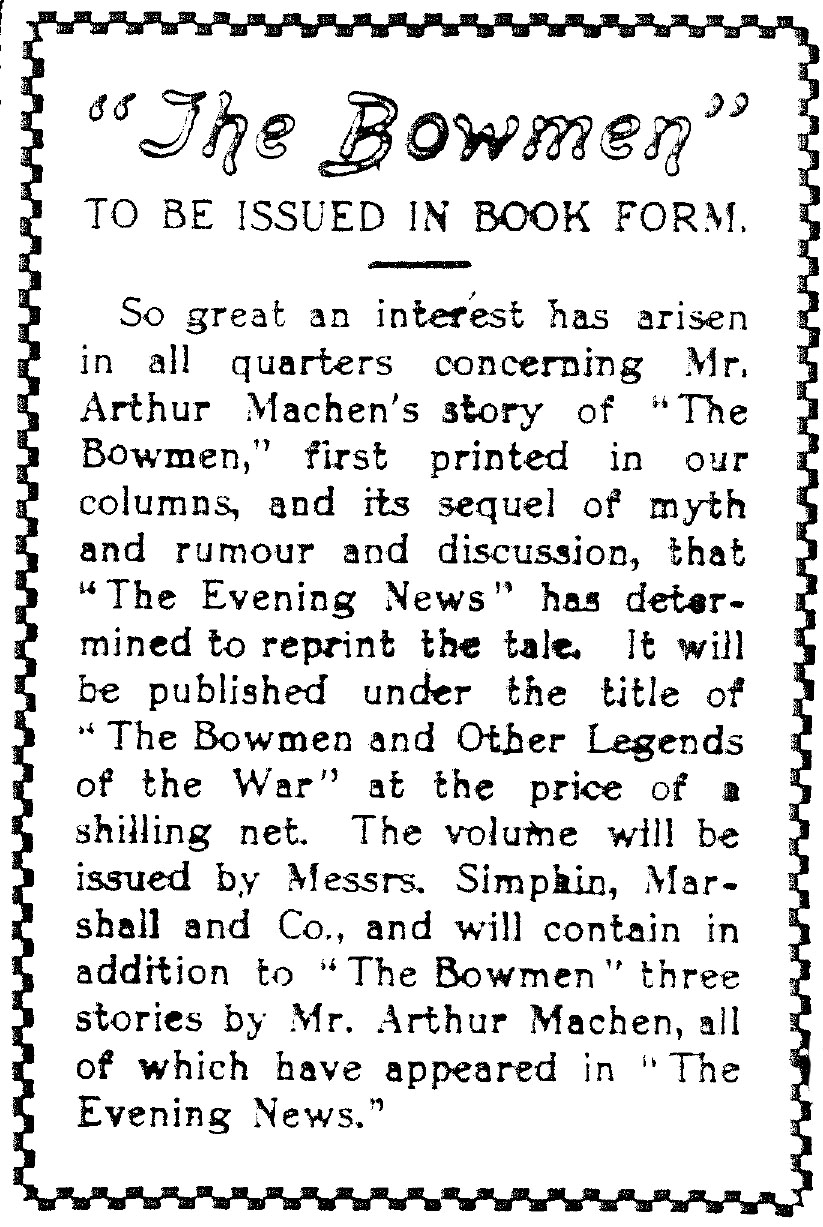
A week after the reprinting of “The Bowmen,” Machen commented on the “great demand” the public had demonstrated for the story. In an editorial preface to that article, the paper announced a book had already been conceived to fulfill this demand. Two days later, on July 29th, the following advertisement was placed in the Evening News. The wording makes it clear that the newspaper carried a stake in the project.
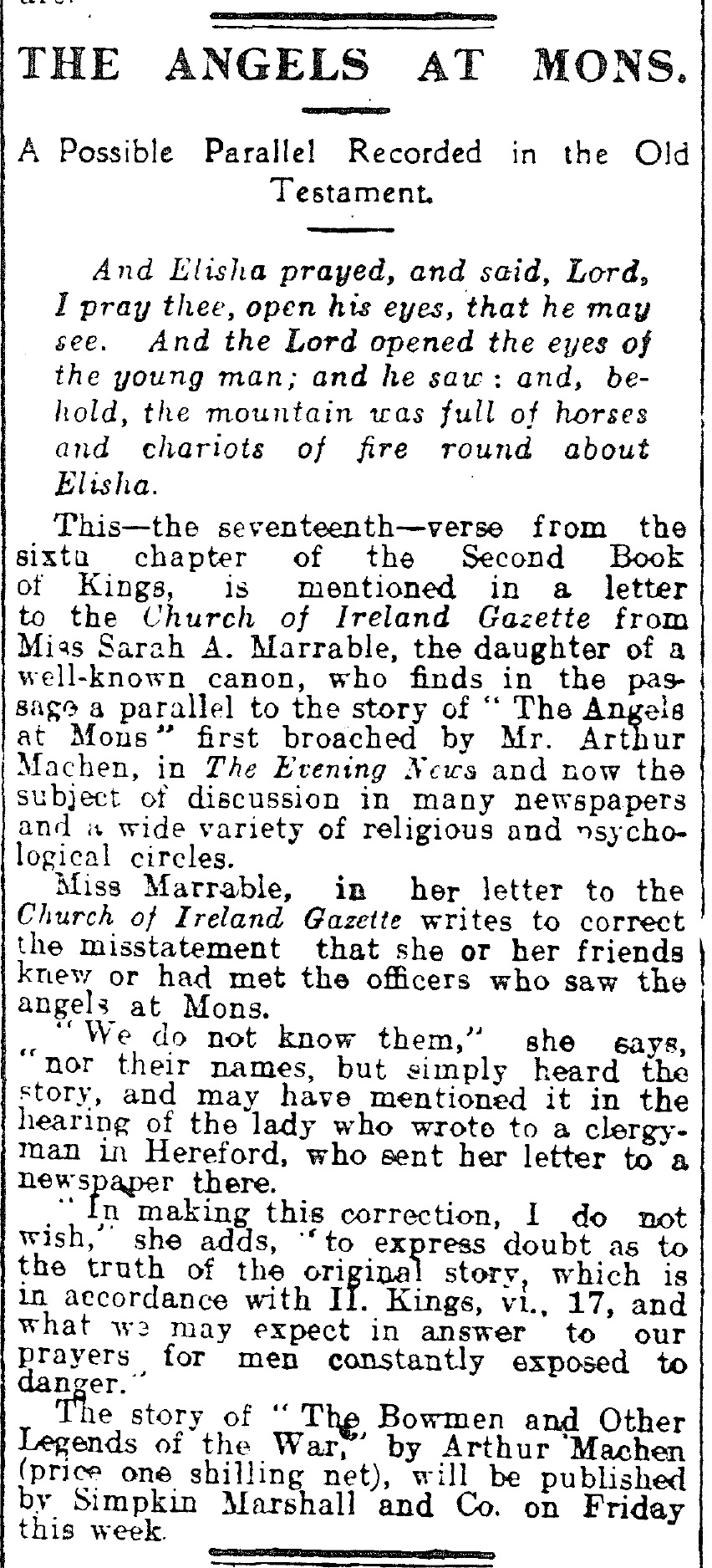
On August 3rd, a small, yet interesting item appeared concerning Sarah Marrable, “the daughter of a well-known clergyman.” Miss Marrable became famous for a brief time for having been incorrectly named as a source for the veracity of the Mons legend. Though she denied those circumstances, Marrable made a public comment on the topic here. At its conclusion, readers were reminded of the upcoming book.
On August 7th, three days before its scheduled release of Machen’s book, an unsigned article, echoing the ongoing “great demand” motif was published. Essentially, this not a true journalistic article, but rather hype-generating “ad copy.”
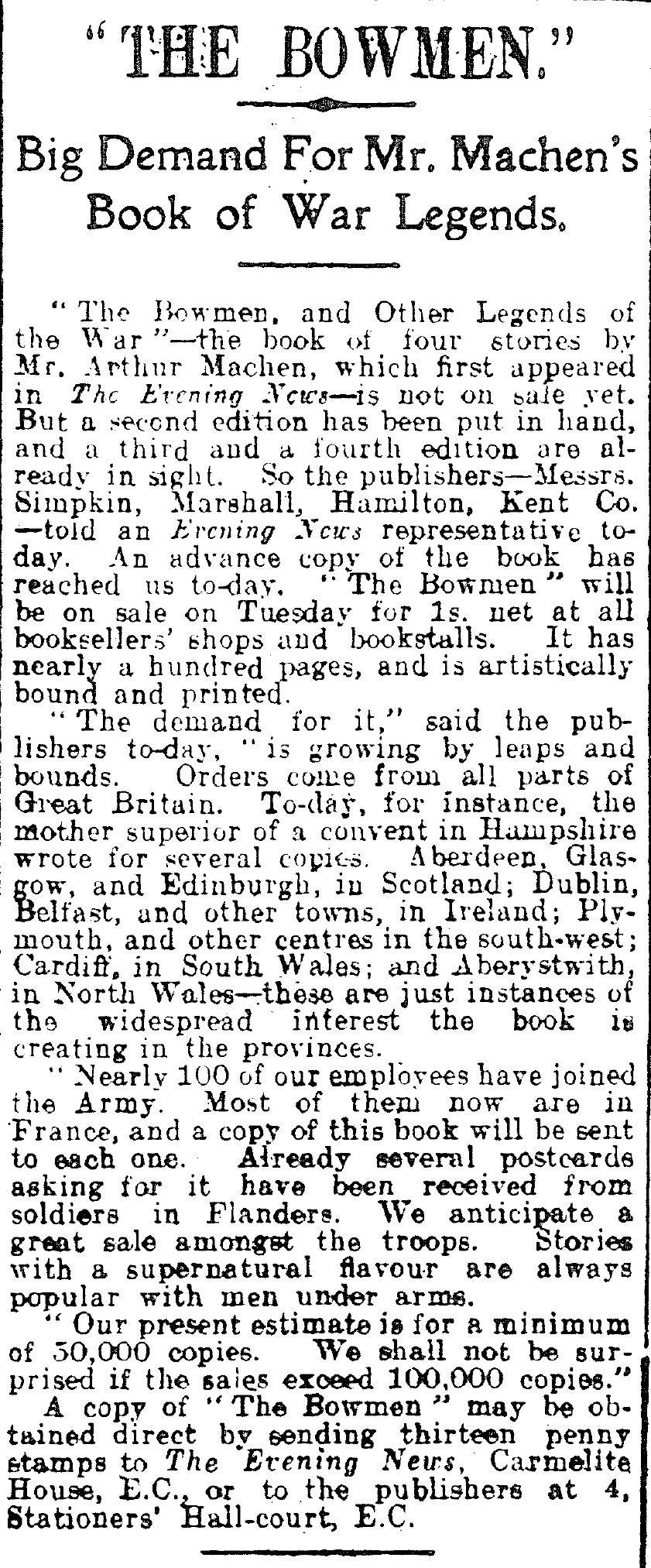
The four stories are “The Bowmen,” “The Soldiers’ Rest,” “The Monstrance,” and “The Dazzling Light.” The book also featured an introduction by Machen, which, in turn, would fuel future comment.
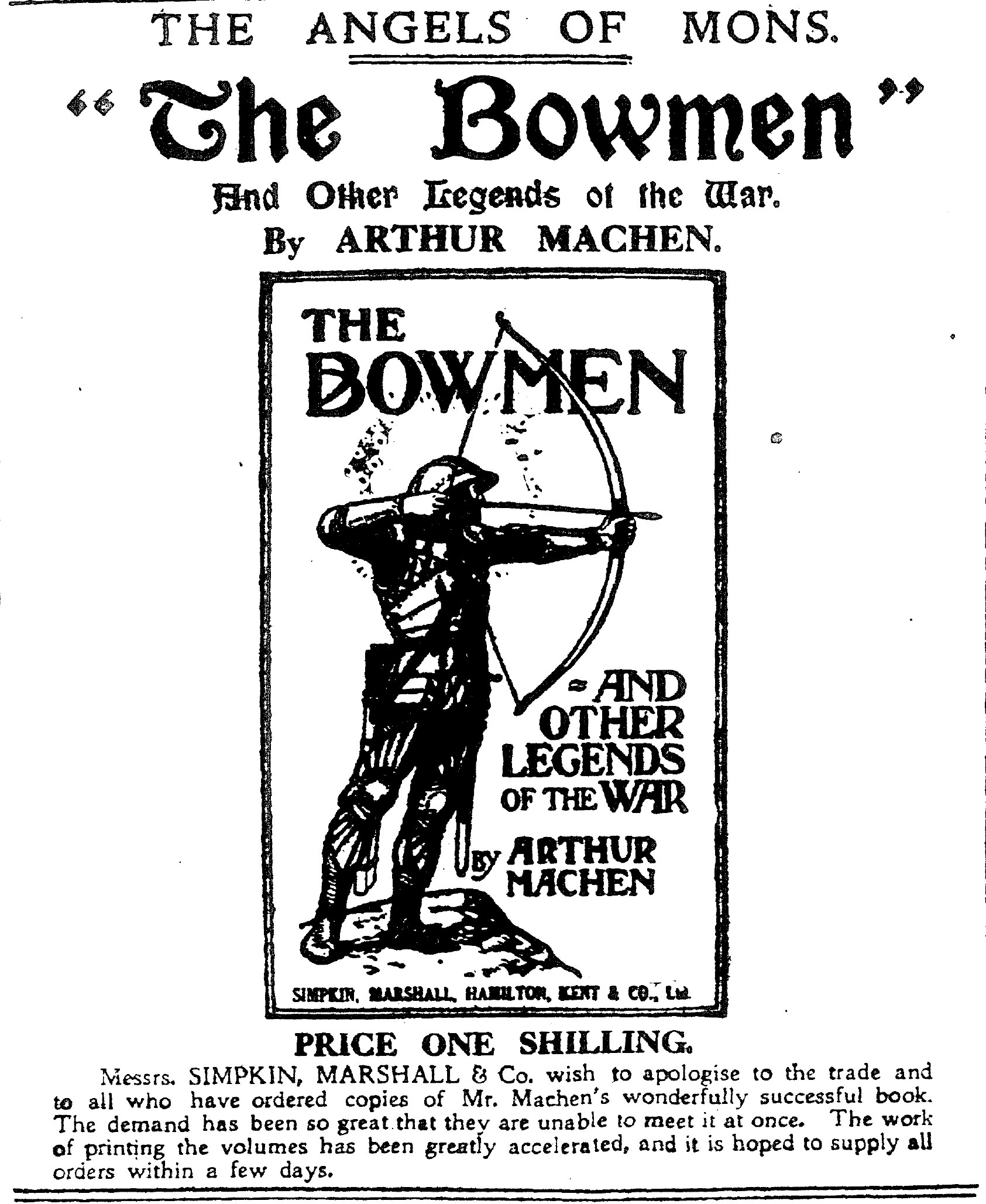
While some of the above claims were certainly true, the presentation was quite dramatic and encouraged interest, thereby deepening the demand. Already primed with months of articles and debate, some readers were no doubt excited by the thought of vanishing copies of a book not yet on sale. The book was published on August 10th by the largest British book wholesaler of the time, though the fact that it could purchased directly from the Evening News further illustrated the paper’s interest in its promotion. The following advertisement appeared on August 9th.
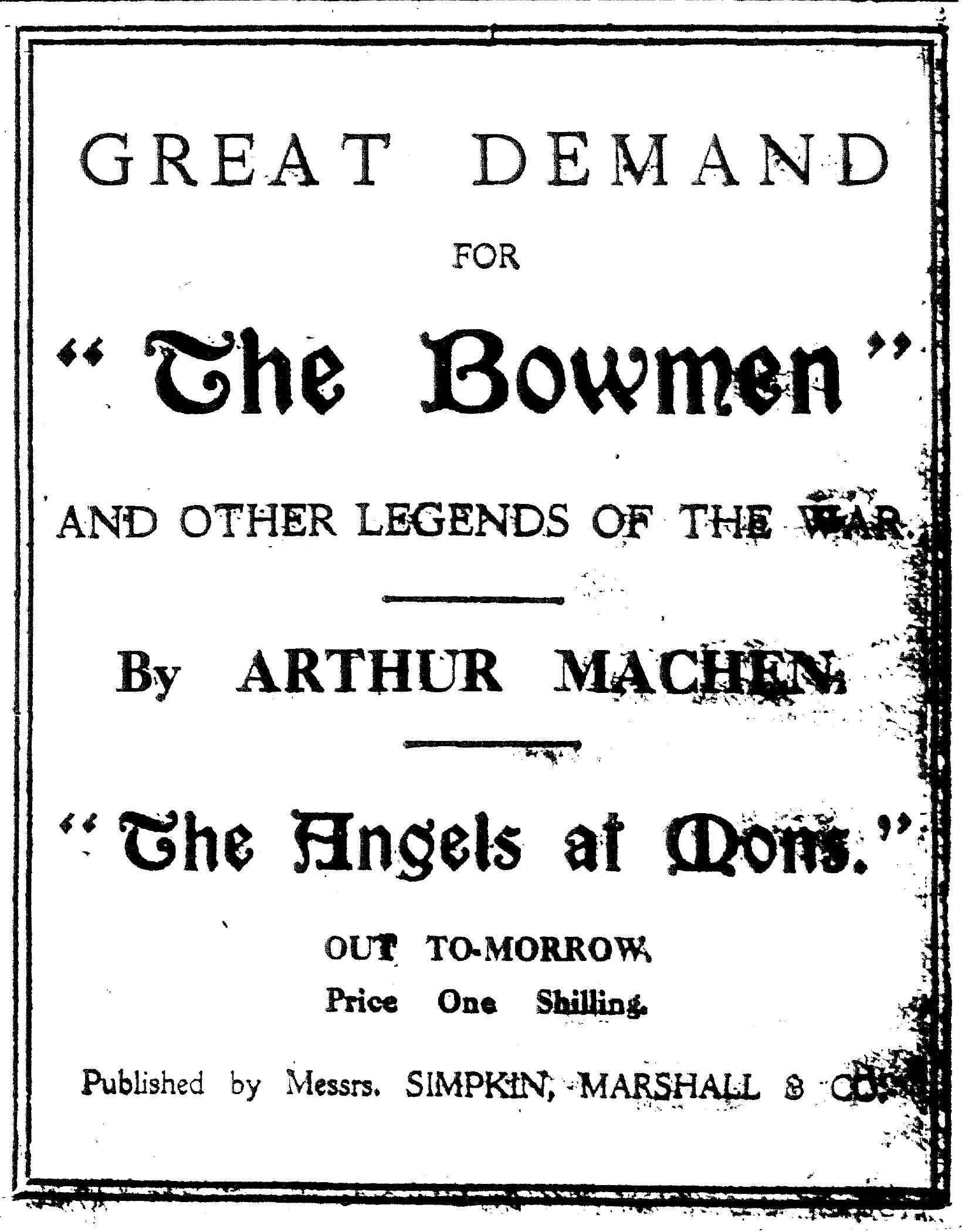
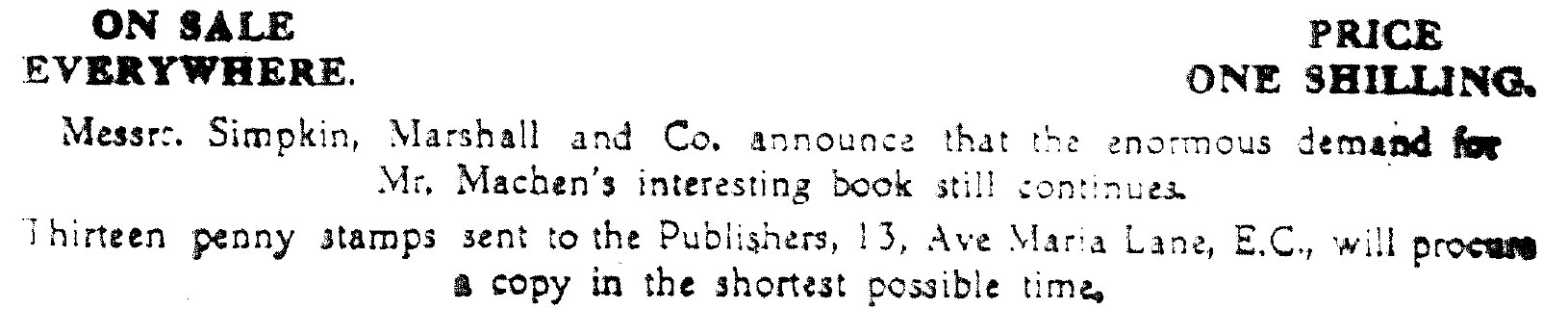
Two days after the book’s release, this ad reappeared with newly added text at the bottom, which is worth noting.
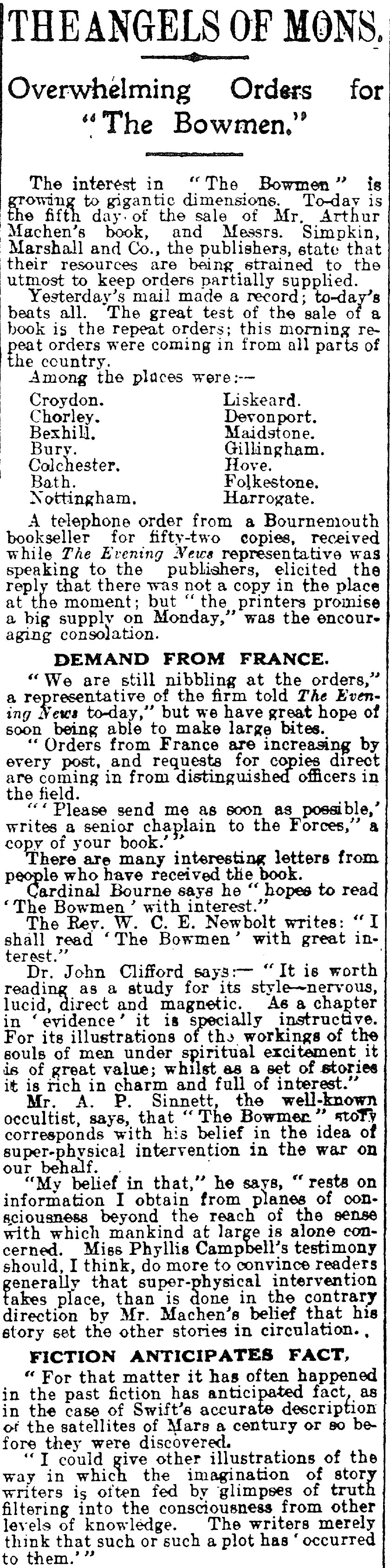
On August 14th, we discover another “ad copy” article, this time illustrating the instant success of the campaign.
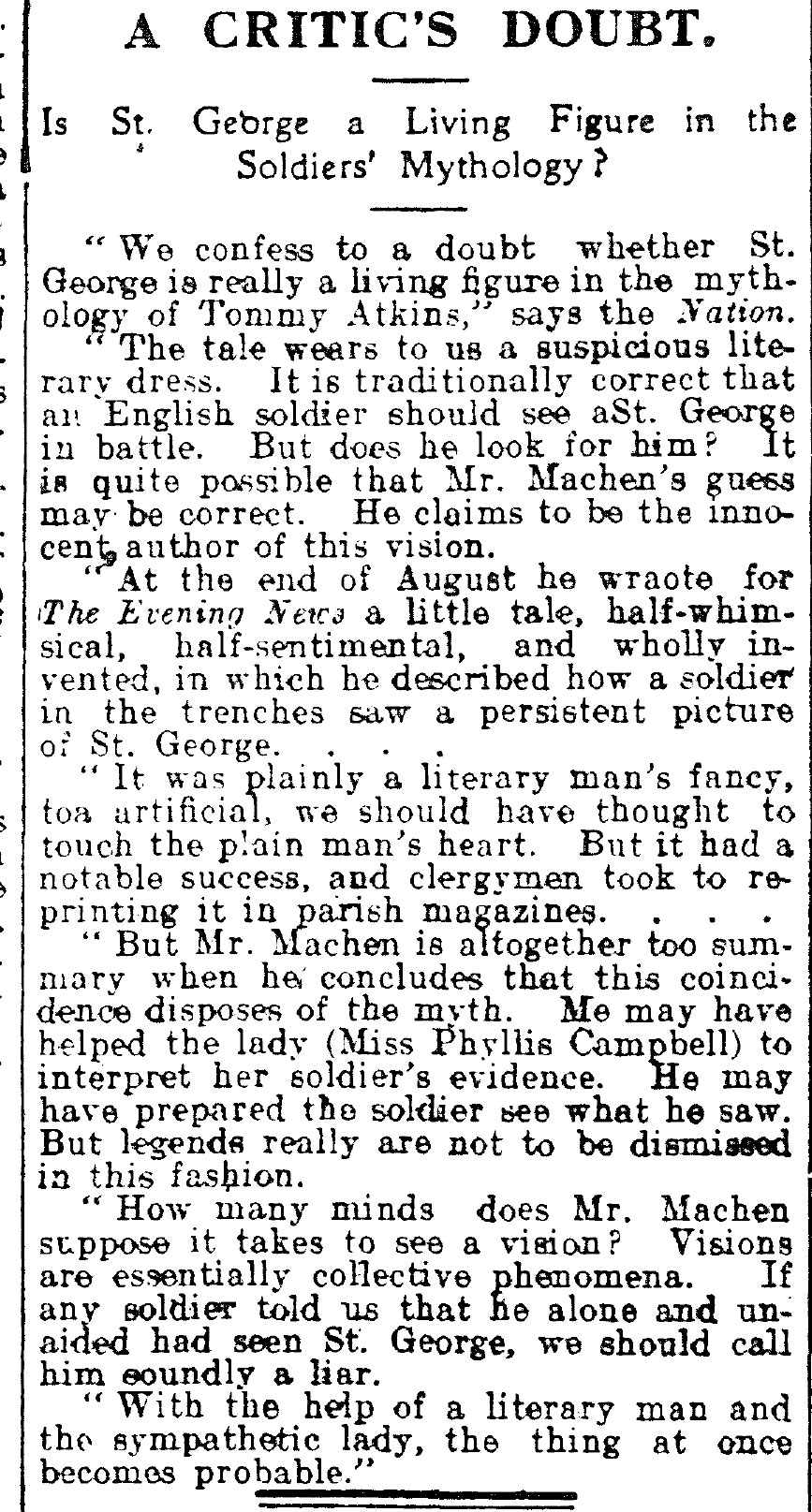
Once again, a critic of Machen’s position is given space so that the controversy is never far from the reader’s mind. Campbell’s article, “Those Angles at Mons,” would be published on August 18th in the Evening News.
Repetition leads to marketing success. Below, “A Critic’s Doubt” is followed by another advertisement—this example excerpted to show new information. These two items and the above “Overwhelming Orders” were positioned in close proximity on page 3.
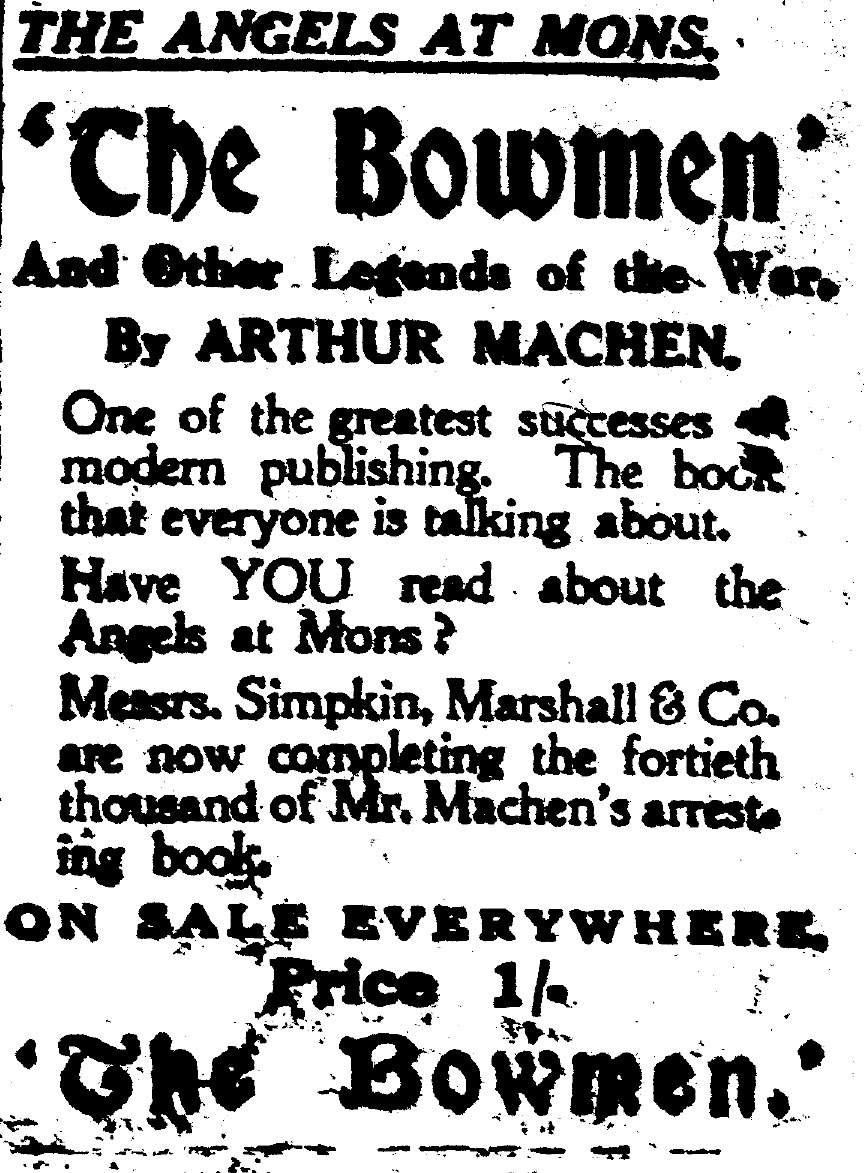
As the weeks passed, high sales continued. In fact, readers were informed on the front page of the September 2nd edition of the paper that the demand for the book traveled far beyond Britain and France. Again, a contradictory response to Machen’s claims has been spotlighted. A smaller ad was included in the bottom right hand corner.
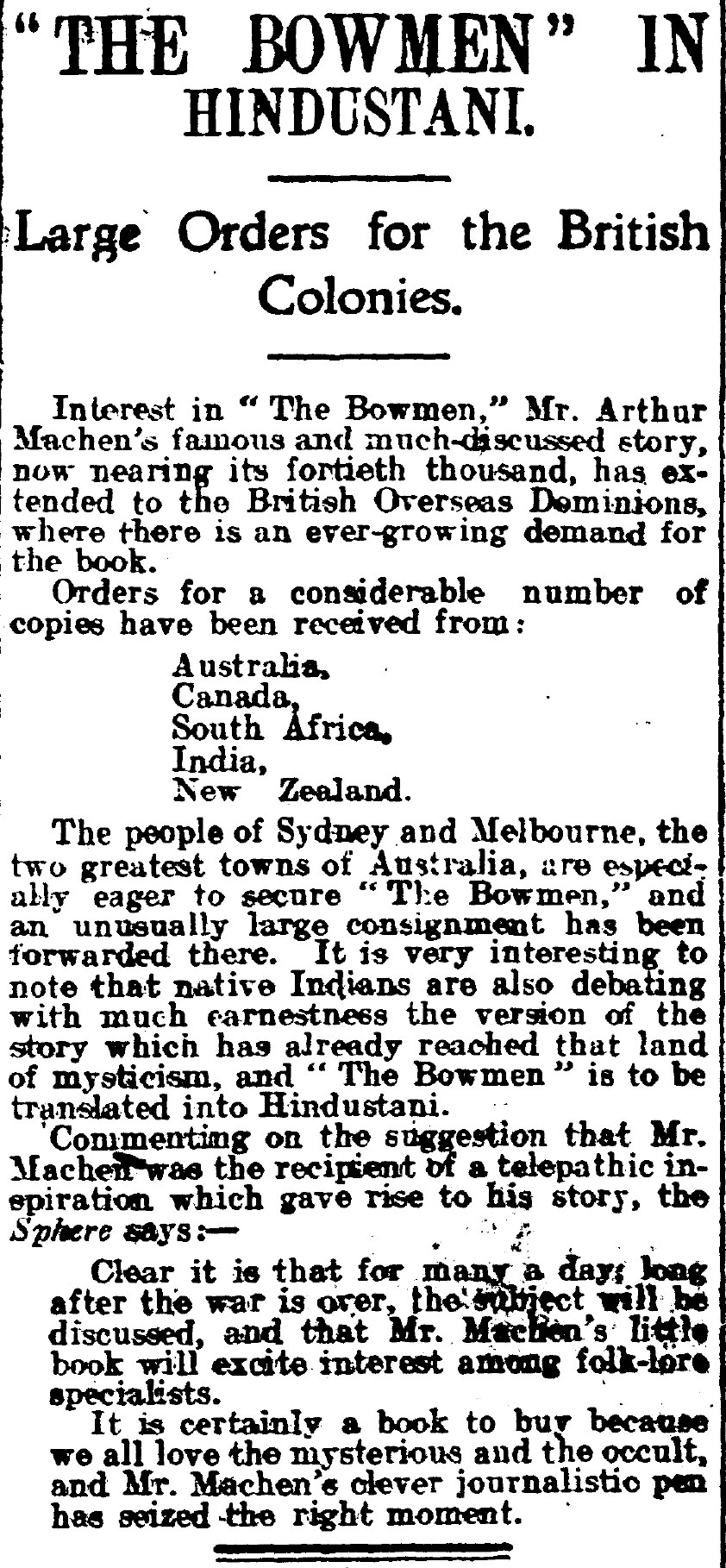
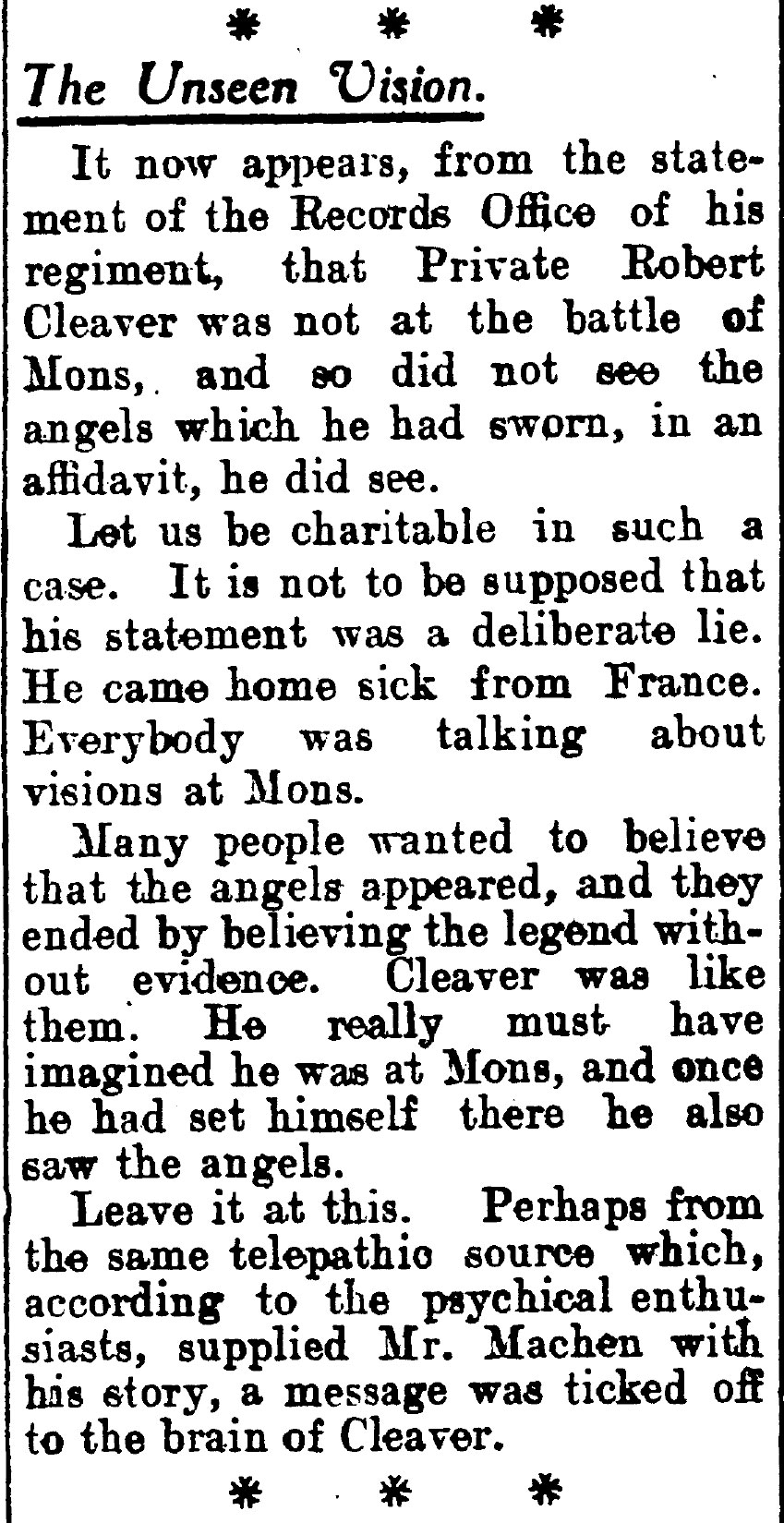
In that same edition of the paper, the following statement was printed. Though the sale of Machen’s book is not mentioned here, it is useful for our understanding of how widespread and deeply confusing the Angel of Mons phenomenon had been for the public. The conclusion of this unsigned item does no favors for Machen’s stated position.
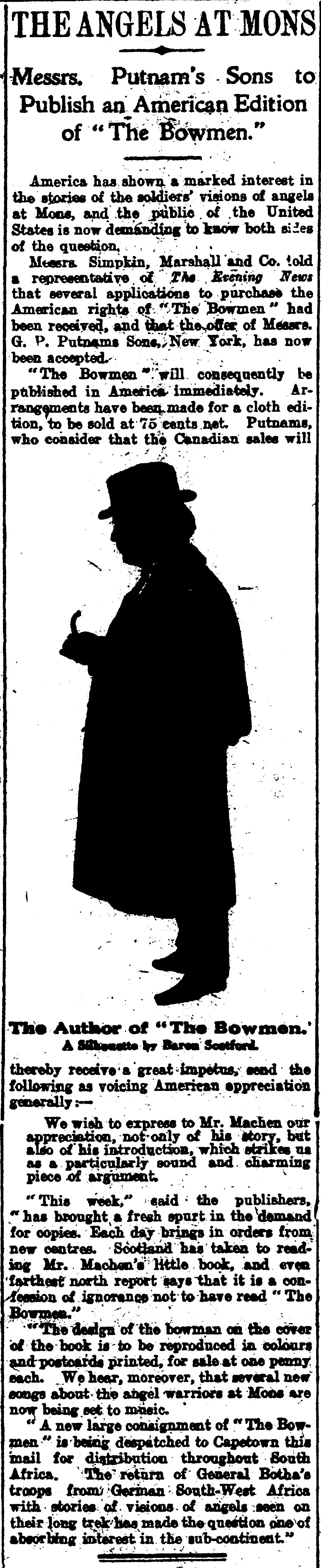
Nearly a week later, the American publisher of the book was announced. This item followed the same plan of reiterating the wide demand for and the unflagging success of Machen’s book. However, it provided some new details.
As with all fads and frenzies, multiple people and organizations were keen to make a profit. Here we see that Machen’s bowmen, and other aspects of the legend, are moving into other formats and media. It would be fascinating to discover how much of this material still exists. The following 78 RPM recording made by baritone Robert Carr is simply entitled “Angel of Mons.”
In addition to music sheets, recordings and postcards, a rival body of literature written by both skeptics and believers alike flooded the market. Some of these rival publications hit the stands before the publication of Machen’s volume. On the same day as the American announcement, September 8th, the Evening News published Machen’s review of Harold Begbie’s book, On the Side of the Angels. (This article will posted in The Weekly Machen section on September 19, 2024.)
. . .
Since the original appearance of “The Bowmen,” Machen had been writing further war stories for the newspaper. However, it was not until the printing of “The Men From Troy” on September 10th, a month after the publication of the book, that his stories received the following by-line: By Arthur Machen, Author of “The Bowmen.” No doubt, this drew the eye to the new story while reminding the reader of the previous triumph—now on sale. All of Machen’s subsequent fiction for the paper, including the serialized installments of “The Great Return” and “The Great Terror” would carry this addition.
The day after the latest story had been printed, the Evening News boldly proclaimed Machen’s thin volume to be the—
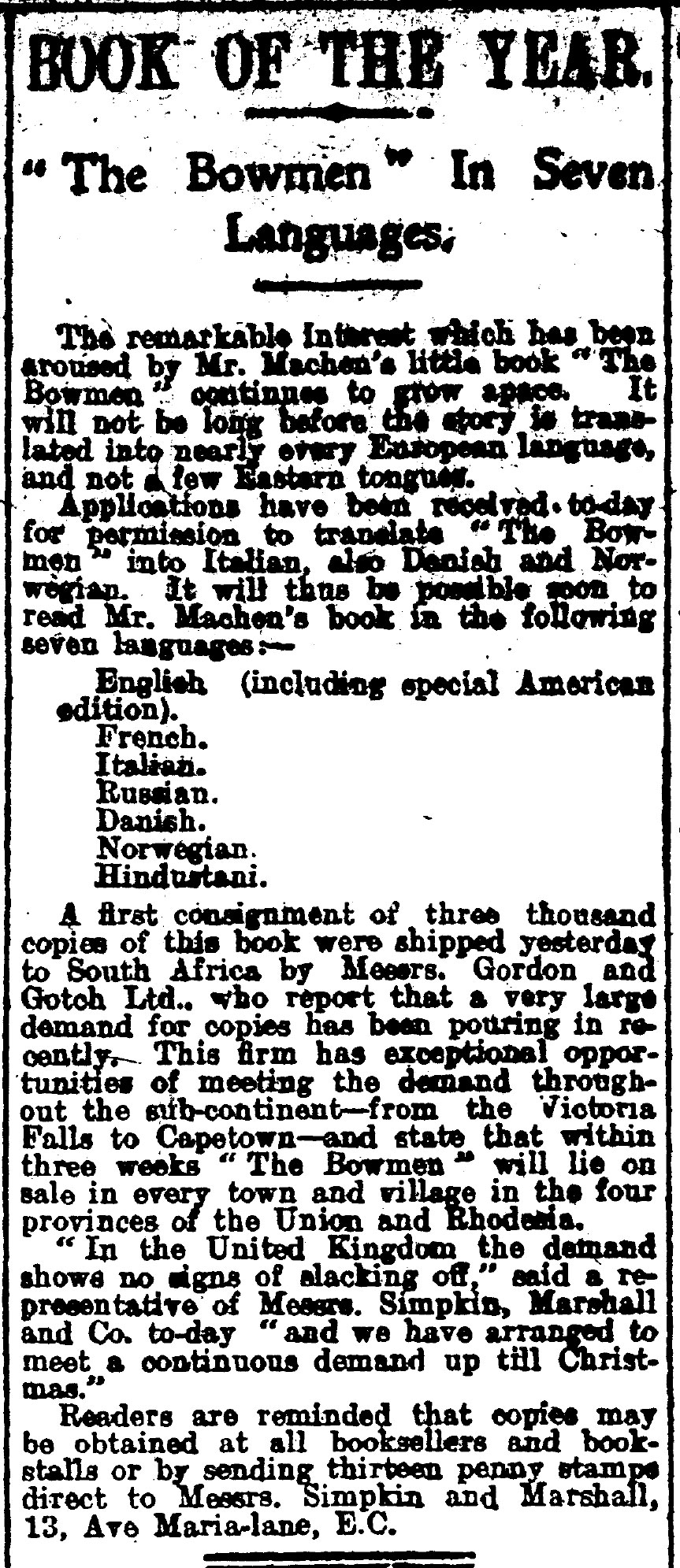
Naturally, I would be most interested to hear from anyone who has reliable information, or better yet, copies of any of these aforementioned foreign language translations. None of these editions are listed in the excellent Goldstone and Sweetser bibliography. Surely, this list is not the fancy of a faceless editor? I sincerely hope not. One further note on this item: potential customers are now directed to search for copies in bookstores and stalls. It is likely that by this time, the newspaper had sold out of its stock of the book.
On October 13th, an astonishing advertisement ran in the paper—
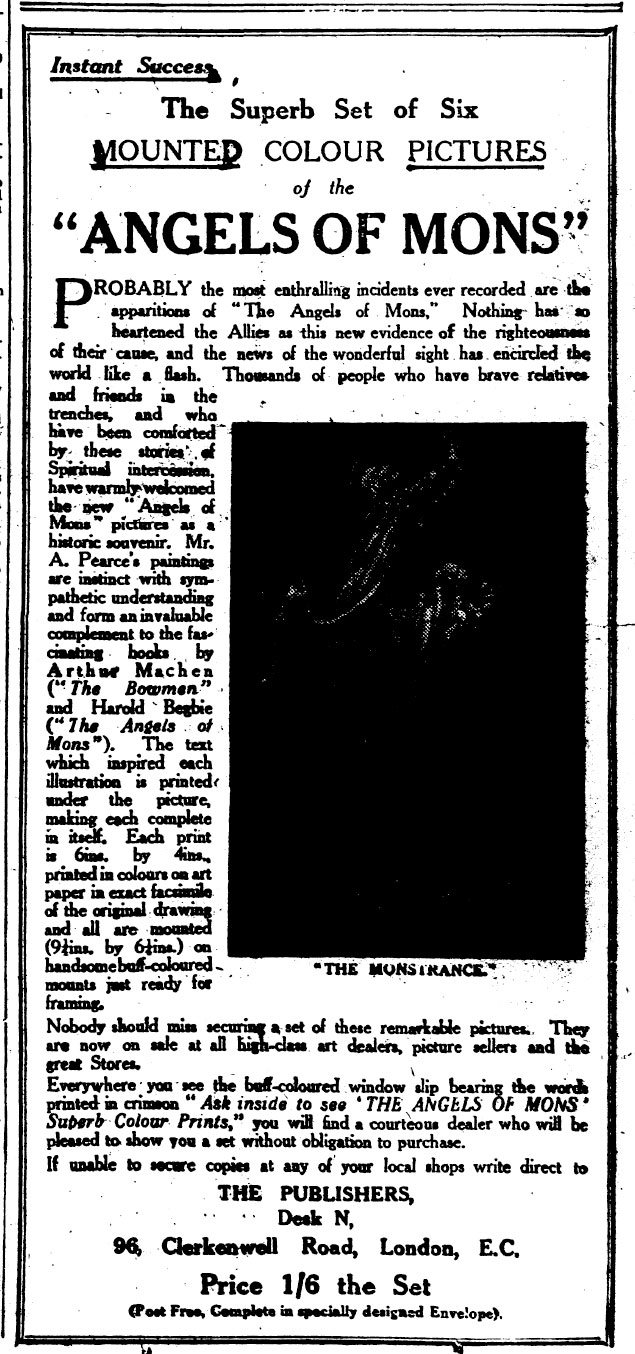
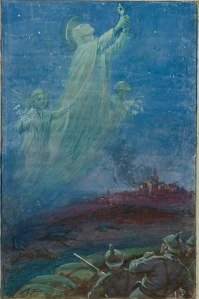
Frustratingly, the image is indiscernible, but the caption shows that the paintings were inspired by not only “The Bowmen,” but other stories in the collections, in this case “The Monstrance.” However, here is the illustration in color.
The next month, the denouement was reached. The following notice from November 6th said it all.
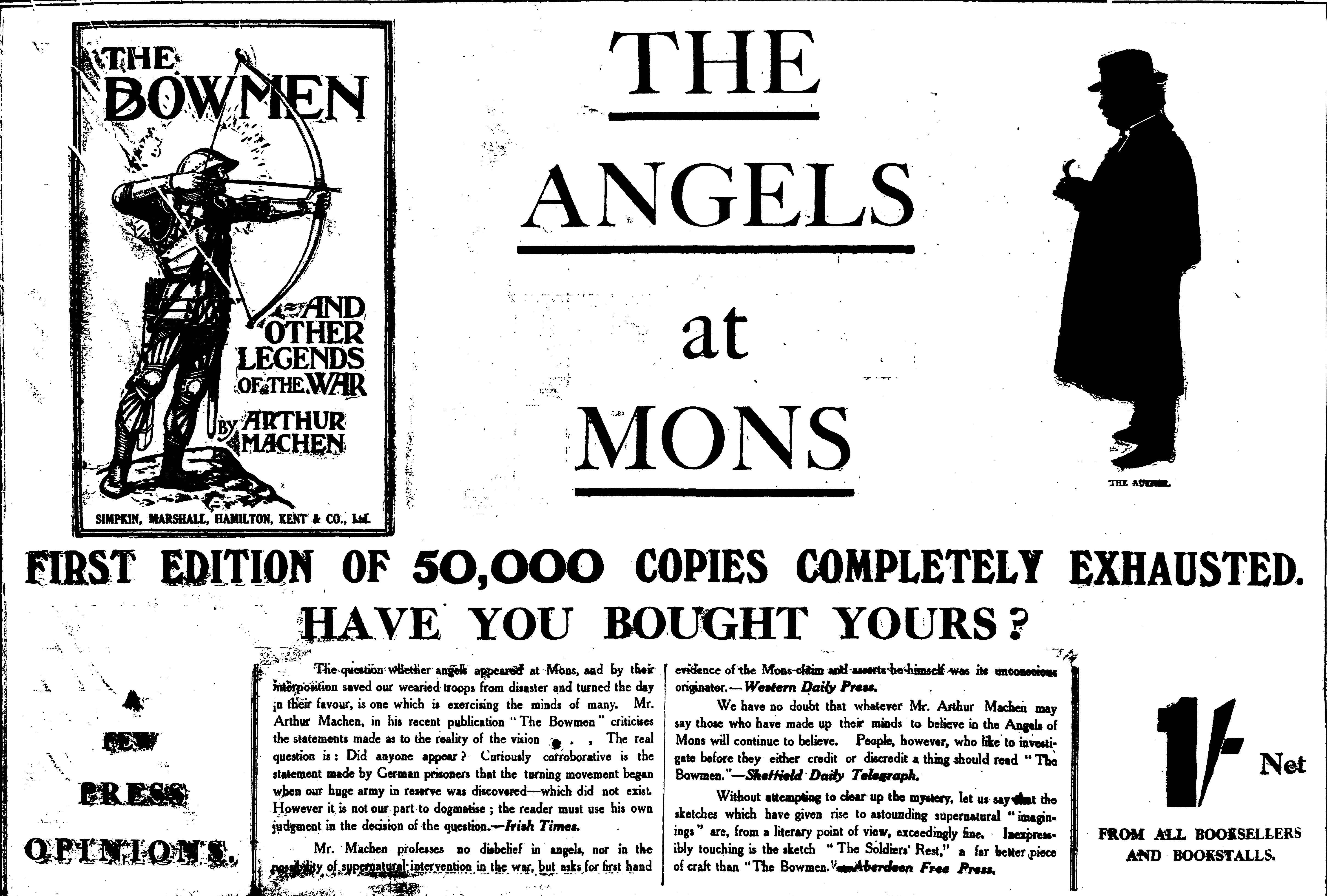
At an incredible pace, Machen’s “Book of the Year” became a best-seller during a troubled war economy. Encouraged by controversy, an aggressive marketing campaign which was augmented by free press, a slew of articles with opposition opinions running counter to its combative author—one who couldn’t keep silent—the book hit the stands and fell quickly out of print within three months. Although we don’t have as reliable sale numbers for all of Machen’s books at the time of their release, it is quite possible that The Bowmen became the most commercially successful work in his lifetime… probably to his eternal chagrin.
Rather quickly, the publishers made good on their earlier promise of preparing future editions. The second incarnation contained two more stories, “The Men From Troy” and “The Little Nations,” and additional commentary from Machen. Issued in red leather, it also was sold in thick boards like the first edition. However, the campaign had largely been fought and won. The occurrences of sensational copy and the number of advertisements declined significantly.
While the quality of the collected stories vary, it cannot be said that any one of them rises to top of Machen’s oeuvre. However, he would continue to publish fiction in the Evening News, some of it vastly superior to “The Bowmen.” Between October 21 – November 16, 1915, the paper serialized “The Great Return.” Like “The Bowmen,” the story was picked up by a publisher to be printed in book form. Yet, it was noted with little fanfare when it saw release in December.
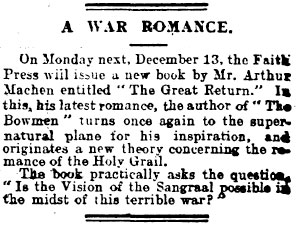
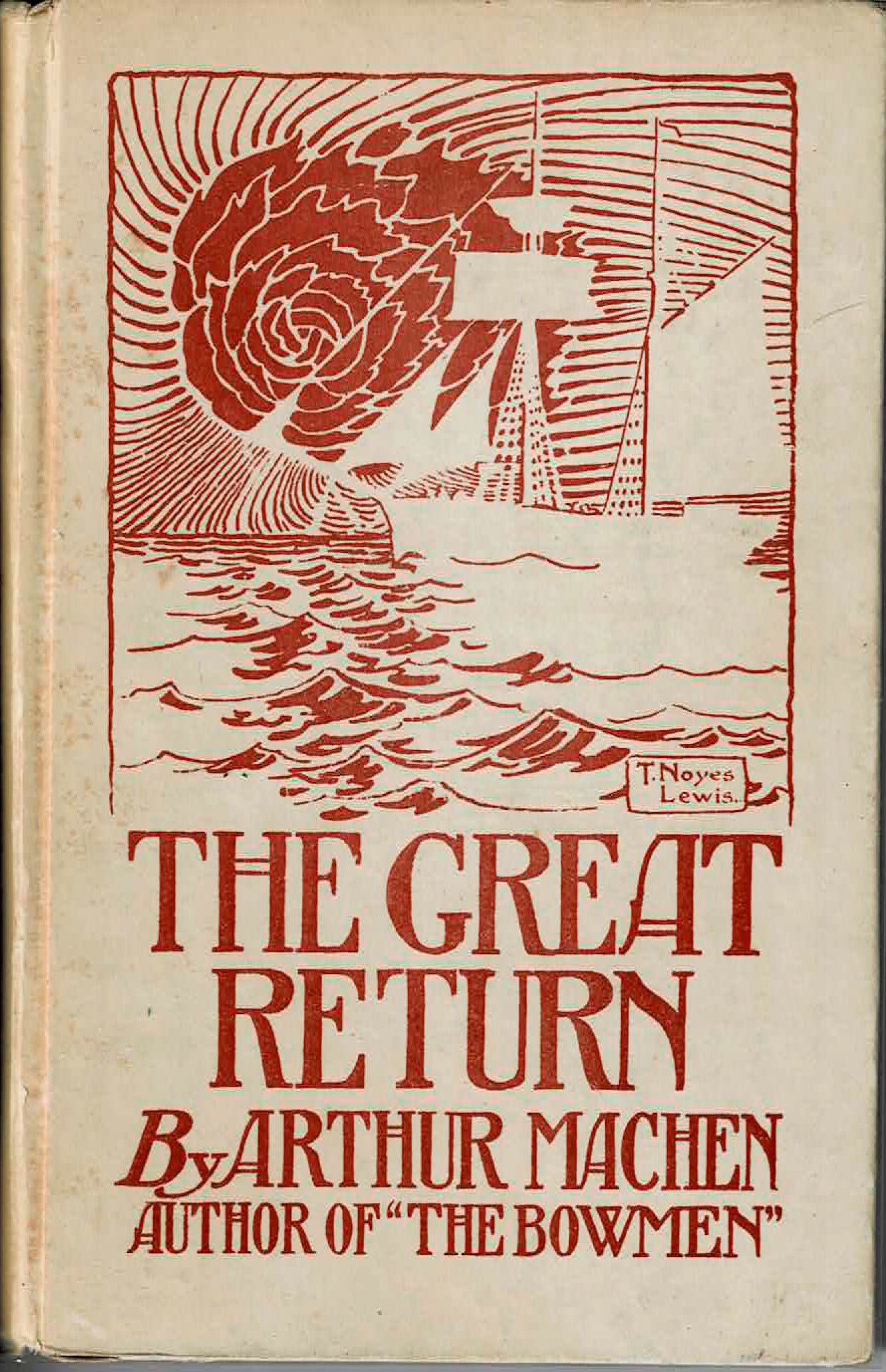
Lightning did not strike twice. Without the enigma of a public maelstrom, the push from an eager daily paper and the backing of a major publishing firm, The Great Return, while aesthetically marvelous, suffered commercial failure. Unfortunately, a similar fate awaited Machen’s longest war narrative, The Terror, which was also serialized before appearing in hardcover. It sold marginally better.
Perhaps Arthur Machen’s status as a best-selling author began and ended with one strange little book.
All original artwork & supplementary material: copyright 2024 by Christopher Tompkins. All rights reserved.
 darklybrightpress.com
Thank you for this richly-detailed history!
The Internet Archive (at the moment of writing) has:
Robert Carr’s song “The Angel of Mons” on the Rexophone label;
John J. Pearson, The rationale of the angel warriors at Mons during the retreat and the apparitions at the battles of the Marne and Aisne, with a resumé of ancient and modern celestial interventions and parallel instances from reliable sources (1915);
Ralph Shirley, The angel warriors at Mons, including numerous confirmatory testimonies, evidence of the wounded and certain curious historical parallels [1915];
while Google Books has at least searchable copies of a 1914 and a longer 1915 edition of Prophecies and Omens of the Great War – but I do not know enough about Google Books to know if there is any way to see the whole book.
LikeLike
I should have clearly said the last book mentioned is also by Ralph Shirley.
Alfred Pearse has English and German Wikipedia articles. The English one includes a pencil and watercolour illustration entitled “The Angel of Mons” – but which is pretty clearly an illustration for “The Monstrance”. The German one includes a pencil and watercolour illustration entitled “St George leading the British”.
Various languages’ versions of the Wikipedia “Angels of Mons” article include a double-page spread from the 29 November 1915 Illustrated London News ‘Christmas Number’ entitled “The Ghostly Bowmen of Mons” “Drawn by A. Forestier”.
LikeLike
Again, thanks! I will incorporate some of this into the article.
LikeLike
Thanks for all these leads! In the article, I should have mentioned an excellent book: The Strange Case of the Angels of Mons by Richard J. Bleiler. It is wonderfully researched and contains many of the original booklets and documents such as Shirley’s book.
LikeLike