
The Weekly Machen
Having acted his final part on the stage in 1909, Arthur Machen then transitioned to his journalistic career the following year. It is not a secret that he despised the latter while adoring the former. For more on Machen’s reminiscences of the stage, read The Stroller. As a beginning newspaper man, Machen was given the opportunity to conduct one his earliest interviews for the Evening News with his acting mentor, F. R. Benson. Beyond the personal affection Machen felt for the man, one may detect a shared affinity in which both the director and the author approached their respective arts: symbolism as a gateway to greater realities.
“The Piper”:
Mr. F. R. Benson on Plays and Players
by
Arthur Machen
December 21, 1910
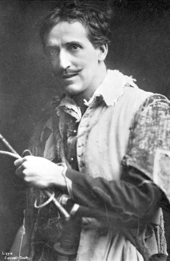 This afternoon Mr. F. R. Benson is presenting “The Piper” at the St. James’s Theatre.
The play, on the old theme of the “Pied Piper of Hamelin,” was produced this year at Stratford-on-Avon. It is written by Josephine Peabody, and won the prize offered by Mr. Otho Stuart.
I found Mr. Benson engaged in all the intricacies of a “lights rehearsal.” He was sitting in the stalls of the St. James’s Theatre, and as I came in I heard a wild cry—or wail. “I want to see Richmond; don’t blot out Richmond.”
The auditorium was dark, but the stage was all lighted up. A beautiful forest scene was set. In the foreground were sombre and solemn pines; and the back cloth showed a peaceful wooded valley, with tall mountain tops rising in the distance.
To the audience’s left there was a wayside cross, and on the step sat a wearied figure in modern costume. This was “Richmond,” one of Mr. Benson’s most devoted and ancient retainers. He was there, I suppose, to demonstrate certain effects of lighting on the human figure: and Mr. Benson’s passionate cry that Richmond was vanishing away signified that the lamps burned too dimly.
Mr. Benson is a practical man; he knows that such details as “lines” and “floats” and “battens” are worth pains and care; but he is above all an idealist.
In his dressing-room, sitting beneath the magic pipe which he will play this afternoon—it is really the pipe of Orpheus, of that enchanter who by his strange melodies forced all the brute world to follow—he expressed a very high opinion of “The Piper.”
The Great End
“It has its technical defects, I admit,” he said, “but I like it because it works in with the great end for which, I think, we are all striving. The piper is, as you say, Orpheus; he symbolises the power of Beauty over the world; the power of which subdues all that is ugly, all that is warring and contentious, all that is base and evil, all that is of a lower nature; resolving the discordant into the perfect harmony. The theme suits well enough, I think, with the Christmas season.”
Mr. Benson spoke warmly of the possibilities of the annual festival at Stratford-on-Avon.
“We keep the feast of Shakespeare,” he said, “but don’t you see that it is not merely a question of doing certain plays year by year? When we celebrate Shakespeare we really celebrate the achievement of the great Anglo-Celtic race. Shakespeare summed up England; he drew from every source; he is at once the dreamer and the man of action; the visionary Celt and the practical Saxon.
“I sometimes dream dreams and I see this feast at Shakespeare’s old town becoming the rallying-point and centre of a great world-empire.
“Did I say Anglo-Celt? I mend the phrase; I will say Aryan. This year the Gaekwar of Baroda came to Stratford and saw our plays and festivals, and he said to me:
I will take back to my own land some of the joy of song and dance and story that I have seen here; and then the two peoples, the English and the Indian, will understand each other’s religion.
The Benson Company
“I think that is a remarkable utterance. Yes; I am a strong believer in the influence of the stage. I think that the drama is the great democratic art; the art which comes home to the people.”
Mr. Benson did not want to talk about the company which he has guided for twenty-seven years; but he yielded after a little persuasion. The Benson Company was formed in 1883 in one of the Scotch “smalls”—that is in a town which is theatrically unimportant.
“I wired to my father,” said Mr. Benson, “that here was a chance of gaining fame and money—and I have done nothing but lose money ever since.”
The manager laughed, not as one conscious of failure.
“Mr. George Weir, who died a little while ago, was a member of the original company; so was Mr. Mollison, Mr. Glendinning, and Mr. Vandervelt, who played leads with Sir Henry Irving at the Lyceum.
“We played all sorts of things in those early days; Shakespeare, old comedy, melodrama, and farce.
“I remember in ‘Rob Roy’ I only had one moment. I knew nothing of the Scotch accent, but there was a struggle, and I worked so hard that for two or three minutes we did a very good imitation of a Rugby scrum.
“There was a wild Highland property man with whom I used to fight. I threw him to earth on one occasion, and I remarked that his struggles were more desperate than usual. I whispered Splendid! Keep it up.’
A Dramatic Ritual
“His death agonies were really wonderful—that evening. I found out afterwards that I had thrown him on a part of the stage that was bristling with nails!
“My effort has always been to preserve what is good in the old traditions and to blend them with the more modern, natural method. I found when I became a manager that the old ways had crystallised into a kind of ritual—into a formula; while, on the other hand, the ‘natural’ people seemed to have forgotten that Shakespeare wrote poetry.
“In Shakespeare the great problem is to combine the two—the feeling of the lines and the music of the lines.
“No. I cannot teach anybody how to act. I can teach people how not to act; awkward and ungraceful, that such an emphasis makes nonsense of the text.
“But I cannot teach a man the right way to do a scene. Why not? Because there is no ‘right way,’ or rather because there are fifty right ways; and every man must find out for himself the mode that best suits him.
“Does Shakespeare unfit an actor for modern, ‘drawing -room’ work? Most certainly not. Do you remember Mr. Asche’s ‘Maldonado’?”
Then Mr. Benson was summoned to see the lighting of the “cave set.”
Previous: The Problem of Tom
Next: The Immortal Story of Captain Scott’s Expedition
 darklybrightpress.com
Machen’s piece reminds me that I was in at, I suppose, the last period of the Oregon Shakespearean Festival, in Ashland, as still basically an Oregon affair. Oh, actors from out of state were on board for some of the major parts, and even, I suppose, some directors, but there was a feeling, it seems to me, that the theater’s productions were still more or less “Oregon” and even “Ashland” affairs. The stage, a not overly fussy reproduction of the Elizabethan stage, was single; not yet the building of other stages. OSFA did little but present Shakespeare, with the intention of presenting the major and most popular plays (say Julius Caesar and The Taming of the Shrew, etc.) more often, but eventually getting round to them all; I think OSFA had been around for decades before, at last, they did Titus Andronicus.
So if Machen had been a local resident he might have been able to play his roles of spear carrier or crowd-scene yeller.
That was then, now is different. And what a difference in ticket prices. But never mind. I suppose I haven’t attended in around 45 years… I’m glad to have the program books for almost all of the summers I attended. (The Elizabethan stage had outdoor seating only. In event of light rain the actors retired, removed their costumes and put on street clothes, and continued, as I understand; I was never present for one of those evenings.)
LikeLike
Fascinating – “In Shakespeare the great problem is to combine the two—the feeling of the lines and the music of the lines.” That seems to have remained a challenge – and “there are fifty right ways; and every man must find out for himself the mode that best suits him” seems true, and to be good advice for acting Shakespeare as well as everything else.
But the worlds of unfamiliar and intriguing drama! – Josephine Preston Peabody’s plays, I find, include a comedy in three acts about St. Francis of Assisi (The Wolf of Gubbio) and a play entitled ‘Marlowe’ (yes: Christopher). Thomas Stange Heiss Oscar Asche (according to the Australian Dictionary of Biography site) and/or John Stange(r) Heiss Oscar Asche (according to Wikipedia) not only played Maldonado in Pinero’s Iris (I’ve heard of Pinero…), but “In Brisbane he met Rider Haggard and discussed with him the stage adaptation of his novel, A Child of the Storm. This was presented as Mameena in London in October 1914, but was not a financial success” (ADB: Wikipedia adds “largely on account of the conditions in London at the beginning of World War I”)- and he played Attila in Laurence Binyon’s tragedy of that name, and King Mark in J. Comyns Carr’s play Tristram and Iseult, among many, many other things. (Well, at least we can try reading some of those plays, online!)
LikeLike