
Introduction
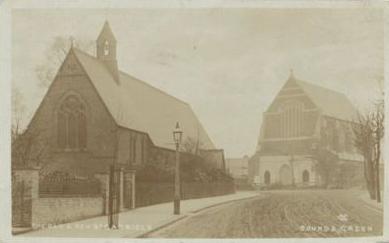
The Hornsey Poltergeist articles of 1921 were first reprinted by J. H. Stewart in his pamphlet From the London Evening News (1959), a keepsake for members of the original Arthur Machen Society. In his introduction, Stewart proceeded over-cautiously concerning Machen’s authorship, since the articles were merely initialed “A. M.” However, there can be no doubt as Machen recounted his involvement in the case in later writings. Yet, I am not bold enough to definitively assign his pen to the following installment since it is not even initialed. Also, the text consists mostly of direct quotes, rendering it difficult to detect Machen’s usual style. Nonetheless, I offer it for two reasons: 1) it may have actually have been written by Machen; and 2) I did not want to cut out the midpoint of the saga which commanded the top headline of the paper. The church mentioned in the article and pictured below, St. Gabriel’s-Bounds Green, was demolished in the 1990s.
The Rackety Ghost Still Busy
Unsigned
February 17, 1921
The mystery of the bewitched house in Ferrestone-road, Hornsey, is to be investigated immediately by the Society for Psychical Research.
Within a few hours of the first publication of the facts in The Evening News, a prominent member of the society placed himself in communication with the distracted household and his services have been gratefully accepted.
The theory that the whole trouble is due to the mediumistic powers of Gordon Parker, the 12-year-old nephew of Mr. Frost, the householder, has to-day received a rude shock.
There was a fresh trouble early to-day when the boy Gordon was not in the house.
Frisky Pincushion
He is to be removed to a home at the seaside to-day, and went away late last night in the company of a local clergyman.
Two other children slept in the same room as their grandparents.
According to Mr. Frost, disturbances were renewed at 7 a. m.
A pin-cushion and other articles were flung from the chest of drawers to the floor.
An orange lifted itself off a chair and dropped on the children’s bed.
A dressing gown was overturned on a chair.
The children, Mr. Frost insists, could have touched none of these things.
THE CRASH IN THE KITCHEN
Tumbling Trays Baffling as Inquisitive Visitor
Members of Mr. Frost’s household have been cross-examined and re-examined during the past few days by numberless inquirers.
They quite admit that their story seems fantastic beyond belief. But they ask the skeptics what motives they could have for concocting such a tale and for breaking up their own home.
As anyone who visits the house can see, the manifestations, whether spiritualistic or not, have done material damage.
Windows and pictures and crockery are broken, and the walls are scarred where pieces of coal have struck the wallpaper.
Pelted With Coal
A woman neighbour who called to express sympathy states that a piece of coal thrown from apparently nowhere struck her on the leg.
Mr. Frost has suffered in health so much that his employer went home with him yesterday to make inquiries himself.
“We sent the boy out of the room while we talked, and hardly had he turned the handle than there was a crash in the kitchen at the back.
“I ran out,” said Mr. Millard to an Evening News representative, “and saw that some trays had fallen down, and the boy was crouching frightened in a corner of the kitchen.”
Mr. Millard confessed himself completely baffled by the case.
Frightened Boy
A prominent business man in Hornsey, who holds several public offices, gave up his day’s appointments to research in the hope of laying the ghost and solving the mystery.
He ended convinced that the seemingly incredible story must be accepted, but without any key to the riddle.
What happened in his case was almost a repetition of the incident that followed Mr. Millard’s call.
The boy went out of the room, and there was at once a crash.
A rush by everyone to the kitchen followed, and it was seen that two saucers which has been on the top of the dresser had been flung to the floor and smashed to bits.
THE DEAD MOTHER’S GHOST
Standing at the Foot of the Boy’s Bed Dressed in Red
The business man concerned has subscribed to defray the expenses of sending the boy away.
“I am convinced myself,” he said, “the boy could not have done it. The whole thing is beyond me.”
Another entirely independent witness is the Rev. A. L. Gardiner, Vicar of St. Gabriel’s, Bounds Green.
Mr. L. N. Frost, whose account of the manifestations has been given in The Evening News already, is connected with St. Gabriel’s Church.
“Mr. Frost told me about the coal flying about on Sunday,” said the vicar, “and at first I was inclined to attribute the trouble to some explosive in the coal.
Vicar’s Experience
“I went to the house on Monday afternoon, and I saw some of the unaccountable things which the family has described with my own eyes.
“As I sat in the dining room I saw pieces of coal dropping as though from the ceiling.
“A white cloth was put on the table and some of the coal fell on the cloth.
“It was just as though some invisible hand was scattering small pieces of coal about the room.
“They were about half the size of an ordinary lump of sugar, such as one would put in one’s teacup.
Dead Mother Vision
“The boy (Gordon) was sitting quietly with me in the room at the time.
“After he and his little brother had gone to bed we heard a scream.
“I went upstairs. Gordon was very frightened, and told me his dead mother had appeared to him dressed in red and standing at the foot of the bed.
“She said he was going to be taken away.
“I saw a parcel and a tin box was thrown from the chest of drawers to the floor.
“There was a tiny fairy lamp on the mantelpiece. It was swept off before my eyes as though a hand had been pushed behind it.
“How it happened I am quite at a loss to explain. I should very much like to know.
“I took the boy home that night to the vicarage, and he slept in a bed beside me and seemed alright.
“Nothing happened at the house while he was away, and nothing happened while he was with me.
“I was at the house again yesterday, and I was afraid of the effect of continued questioning on the boy. I got him out of the sitting-room and took him upstairs.
“As soon as he reached the landing he exclaimed:—
“There she is. There’s mother,” and said he had seen his mother dressed in red as before, and that she had passed into the room in front of us.
Boy “Perfectly Normal”
“He was shaking violently and greatly frightened. I myself could see nothing.
“I have known the Frosts for some years, and the funeral of the boy’s mother, Mrs. Parker, took place from St. Gabriel’s. She is buried at New Southgate.
“The boy has been medically examined and pronounced to be normal.”
The vicar produced a doctor’s certificate obtained with a view to ensuring the boy’s admission to a home in the country for a few weeks’ change.
“The idea that the boy could have thrown things about in this way is nonsense,” said the Vicar.
Cleverer Than Devant
“He has been constantly under observation, and if he could do all these things and deceive everybody for weeks he must be cleverer than Maskelyne and Devant.”
Like the clergyman, the family doctor, Dr. E. A. Lemerle, of Turnpike-lane, Hornsey, spoke in high terms of the Frosts and confessed himself baffled by the strange series of events.
Dr. Lemerle attended Mrs. Parker during her last illness. She died a perfectly natural from consumption, he explained.
The Frosts have lived in Ferrestone-road—a short thoroughfare flanked by well-built modern three-story villas—about eleven years.
Until three weeks ago nothing uncanny had disturbed them.
The Weekly Machen
Previous: Hornsey House of Nightmares
Next: Two Unsigned Articles on the Hornsey Saga
 darklybrightpress.com
Interesting. I don’t think it’s by Machen, though.
Quite a dreadful account of uncanny events is provided in Blumhardt’s Battle: A Conflict with Satan (English translation by Frank Boshold, 1970). This relates to the experiences of the German Lutheran pastor Johann Christoph Blumhardt and a young woman named Gottiebin Dittus in the 1840s. It is also recounted in Johann Christoph Blumhardt: Life and Works, A New Biography by Dieter Ising (2009).
LikeLike
I should add that the key theme is “Jesus is Victor!”
LikeLike
Thanks for this! I see the Internet Archive has a scan of a 1934 edition of Die Krankheitsgeschichte der Gotlieben Dittus in Möttlingen – in Frakturschrift – and an audiobook of it (with, I see, various audiobook uploads on YouTube, at least one apparently of by a different reader: all starting the title with “Sieg über die Hölle“).
LikeLike
Thanks for this follow-up – from the day after the first in the series!
Of possible related interest, I went looking to see which – if any – possibly more-or-less contemporary editions of Crockford’s Clerical Directory might be scanned in the Internet Archive – and learned from the 1949-50 one (OUP, 1950) that Alexander Leopold Gardiner had by then been Vicar of St. Gabriel’s, Bounds Green from 1906-39 and was “L. to Offic. Dio. Guildf. from 1939” – which (checking the “Abbreviations” list, pp. xx-xxi) I take to mean ‘Licensed to Officiate in the Diocese of Guildford’ – with a current Guildford address and telephone number.
In the antepenultimate sentence/paragraph I would expect the noun ‘death’ between “natural” and “from”.
LikeLike
Reading of the members of Frost’s household sensibly asking “the skeptics what motives they could have […] for breaking up their own home” coinciding with reading Warren Lewis quoting Laurent, Chevalier d’Arvieux in Levantine Adventurer (1962) about astonishing English (merchant) behavior in Smyrna in the mid-17th c. got me wondering about all sort of odd customs, folklore, and superstitions, which I have so far followed to the English Wikipedia articles, “Polterabend”, “Yefim Smolin”, and “Plate smashing” – which has a list of yet another six article under “See also”.
LikeLike