
The Weekly Machen
We conclude Arthur Machen’s journalistic writings on Irish Home Rule with an interview he conducted three years before his trip to Belfast. Novelist and politician Justin McCarthy spoke with our reporter on the great British leaders of the past and offered predictions for Ireland’s future. He did not live to see Home Rule or independence as he died two years after this discussion.
An Irish Leader of Yesterday:
Mr. Justin McCarthy and Home Rule To-Day
by
Arthur Machen
November 10, 1910
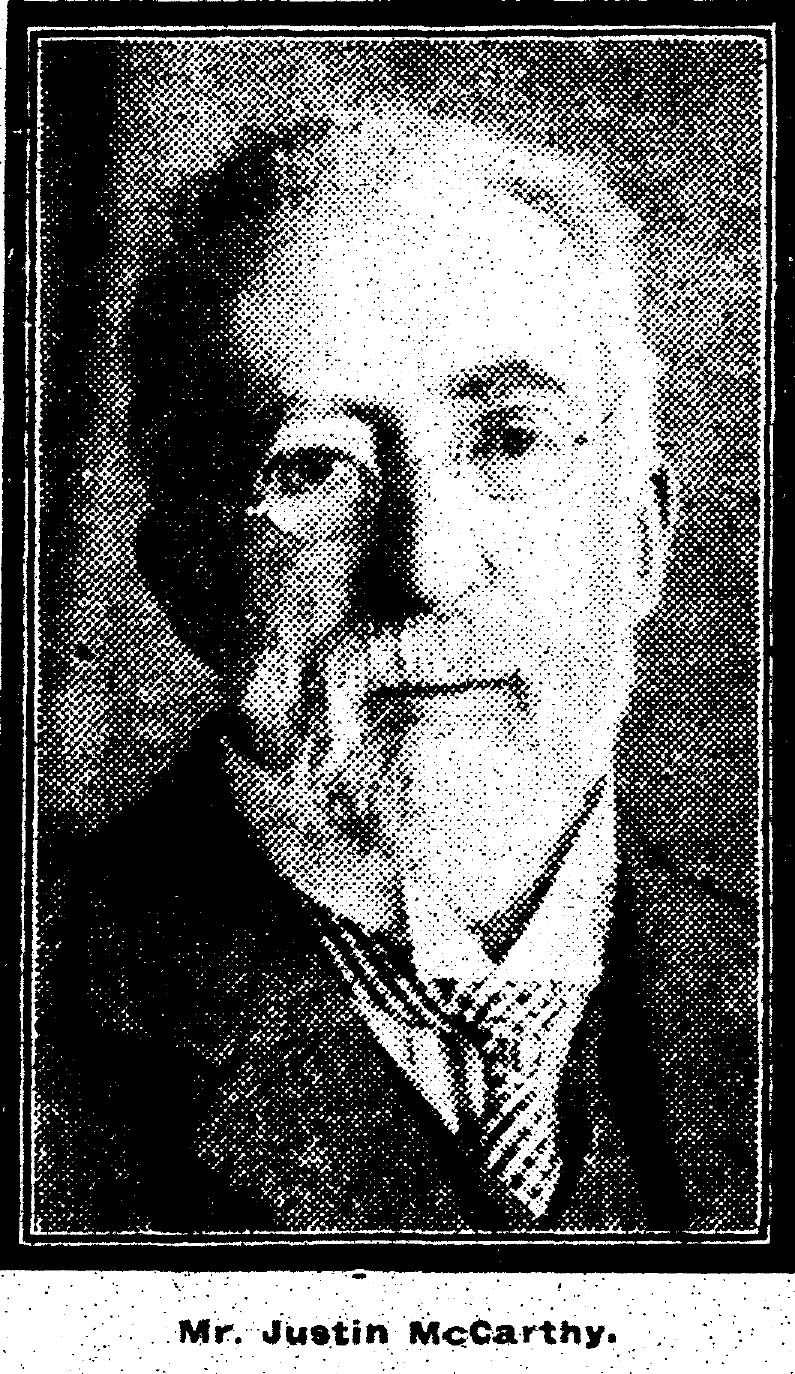
Mr. Justin McCarthy, the veteran novelist, historian and politician celebrates his eightieth birthday this month.
Thirty years ago, I remember buying the Christmas number of Truth.
It was in the autumn of the year that had dismissed Lord Beaconsfield into retirement, and had placed Mr. Gladstone in power with a big majority.
Liberals were in high feather; they said that the country had come to its senses, and that great things were to be done. And, amongst other attractions, that Christmas number of long ago told us something of the tasks with the triumphant Liberal Administration was to accomplish.
Chief amongst them was the crushing of the Home Rulers. Mr. Gladstone has not yet made his speech about “marching through rapine to the dismemberment of the Empire,” but the speech was already in the air, and Truth has a picture of the Gladstone Government crushing the Hydra of Irish Rebellion.
The Hydra had many serpent-heads, and one of them, wearing spectacles, was Mr. Justin McCarthy.
And now I have just seen Mr. McCarthy in his pleasant home at Folkestone; and though he wore spectacles, he does not look at all like a serpent.
On the contrary, Mr. McCarthy is a personage of an extremely kindly and benevolent aspect; and he was good enough to receive me with all the courtesy and consideration of a past master in journalism to a younger brother of the craft.
It will be remembered that Mr. McCarthy succeeded Mr. Parnell in the leadership of the Irish Party in the House of Commons. The tale of Parnell’s fall is a sorrowful one, and for a time passion ran high. So it was with a certain delicacy that I mentioned the name of the famous leader.
Parnell’s Broken Heart
“Parnell? I once discussed him with Mr. Gladstone; and Mr. Gladstone said to me, ‘Whatever Parnell was, he was a great man.’ And that is, above all, my own conviction.
“And I think that it was in the course of the last talk I ever had with Mr. Gladstone that he said, ‘Never in the somewhat long course of my parliamentary experience have I met a man to equal Mr. Parnell in this one matter: he had the art of saying every word he wanted to say, and not one word more. In this he stood alone; he was above Palmerston.’
“Poor Parnell. He died of a broken heart.”
Mr. McCarthy hinted in guarded terms that the incident which brought ruin on the Irish Dictator was not altogether unique in his history. Perhaps the sentence conveys rather more than Mr. McCarthy’s intention. He meant, perhaps, that Parnell was one of those men who are not happy without some egeria or other.
Mr. McCarthy thinks that the Irish people are very near to the achievement of their desires.
“Home Rule, depend upon it, is not far off. It will be granted with the consent of the Conservative party, with the general good will of England.”
He has, of course, the greatest reverence for the memory of Gladstone. But he agreed with me that there was something “suspicious” in Gladstone’s conversion to the principle of Home Rule.
A Sudden Conversion
I pointed out that Mr. Gladstone had gone to the country demanding a majority against the combined forces of Ireland and Conservatism. He failed to obtain it, and became a Home Ruler.
“Yes,” Mr. McCarthy agreed, “it was rather sudden.
“Gladstone’s great failing was a total lack of humour. He could not see a joke, he could not make a joke, he could not understand a man who saw jokes or made them. So he never could understand Disraeli.
“He was a great contrast in this respect to Bright, who was an extremely humorous man. Yes, I always thought Bright a greater orator than Gladstone. Bright was clear; Gladstone’s sentences were like a nest of Chinese boxes.
“I had an intense respect for Disraeli. He had in him the spirit of right; he always desired to do the right.”
Mr. McCarthy has lived a strenuous and laborious life, but even now, at the age of eighty, he has by no means given up all work. On his desk was a copy of “Lady John Russell.”
“I am going to review the book for the Fortnightly,” said Mr. McCarthy.
The review will be looked for with interest, as Mr. McCarthy was an intimate friend of the late Countess Russell.
“Do I think that Socialism has any future in Ireland? Never! Remember above all things that the Irish are a Conservative people and a religious people; Socialism cannot possibly make any appeal to them.”
Previous: A Drive Through Belfast
Next: The Craving to Scream
 darklybrightpress.com
Who’d have thought, years ago building his Machen library with the two Pinnacle paperbacks of horror stories and the Ballantine Three Impostors, that this legend of supernatural fiction would write columns reporting political reminiscences — something more suited, one might eventually have thought, to a follower of Trollope rather than Dickens? I’m impressed.
LikeLike
Though I wouldn’t call Machen a “political thinker,” he did think about politics. It comes out in his writings only occasionally. In the coming months, I’ll be posting a series that Machen wrote on the labor question. This series was conceived as a counterpoint to a series written by H. G. Wells on the same subject. I think it will be quite interesting to readers of The Weekly Machen.
LikeLike
Fascinating – thank you (including the links)! And, what a prolific and varied (and unfamiliar) writer McCarthy was – and his son with, and after, him. And, as Dale Nelson suggests, what a vivid, informed glimpse Machen gives of him. (The Trollope of Palliser, especially, sprang to my mind, too – and now I wonder what McCarthy and Trollope may variously have said of each other – and what (more) Machen may have said, too?)
“Remember above all things that the Irish are a Conservative people and a religious people; Socialism cannot possibly make any appeal to them.” Alas, how sadly that has failed to prove correct – from just how early a point, I wonder?
LikeLike
Yes, I agree. No doubt, McCarthy would be shocked at some of the developments in modern Ireland.
LikeLike