

The following article was published in the February 27, 1926 edition of T. P.’s & Cassell’s Weekly. A short commentary follows.
March 1: St. David’s Day
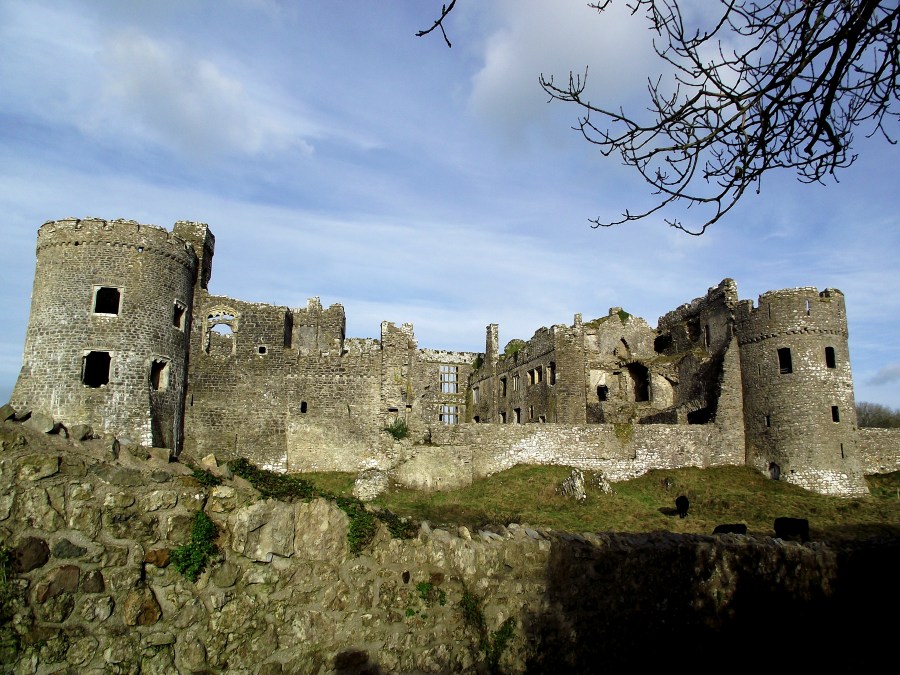
It rained all the day long. The course of the party in the two motor-cars lay from beautiful Tenby in the south of Pembrokeshire to far St. David’s in the north-west; and the rain began at Carew Castle, sweeping from the Atlantic ocean.
One of the drivers was weatherwise; he said that the rain would last till the turn of the tide in the afternoon; but we were persistent pilgrims and we bade the men to drive on.
Old Banquet Glories of Carew
It was but a drizzle at Carew, and at the request of one of the Americans of the party, I led him past the great Celtic Cross by the wayside, past the memorial bakehouse with its round “Flemish” chimney, into the castle.
The American tried to reconstruct the past and did it to his satisfaction. I can never do much in that way when all about me is broken and ruinous; but in Carew Castle there are remains of the age that came after the mere fortress period; a noble banqueting hall of the early sixteenth century, with a flight of steps going up to it, a rich and splendid place. Carew visited, we climbed back into our car, and the rain came thicker and faster upon us, and we still drove on.
We came to Haverfordwest, a little huddle of a town with a great castle on the hill above it; and from Haverfordwest we seemed to climb higher and still higher, till we had mounted to a far-reaching tableland, desolate, treeless, deplorable. And here the rain, heavier and still heavier, blew like a sheet of water from the ocean.
It was now too late to think of turning; so we drove on through the wilderness of land and the wilderness of water—yn y wastad, which means in Welsh either “into the wilderness” or “and ever shall be,” both time and space being conceived as wilderness.
The Cathedral City
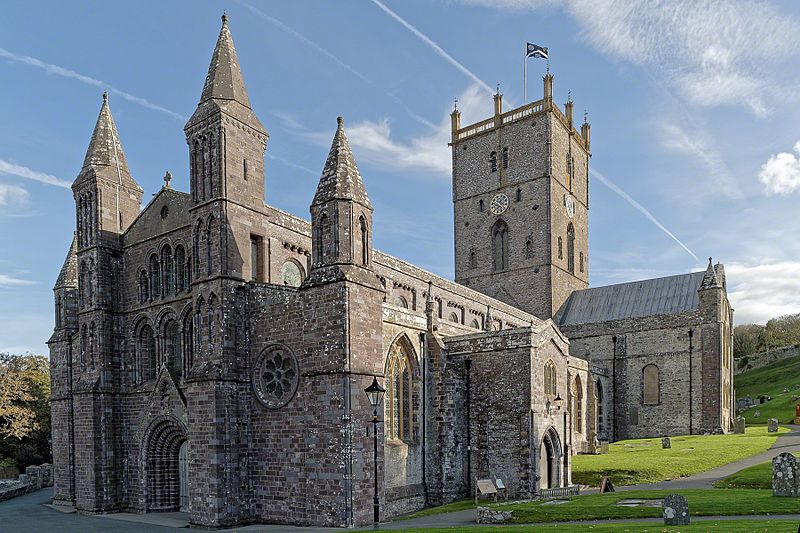
We went down terrific hills, we went up terrific hills; and then the dreary monotony of the land was broken. There were grey, grim, sharp-toothed rocks, and the foaming and the roaring of the sea, as it rushed in from the Atlantic. And at last St. David’s, the cathedral city of the patron saint of Wales.
To this day I do not know whether I saw the city, whether there is any city to see. The cars stopped at an hotel which seemed to me in the middle of the fields; but I am bound to say that, peering through the everlasting rain, I could see no town beyond. But down below in a deep valley was the cathedral, and near by it the palace, glorious in beauty though all ruinous.
The Relics of St. David
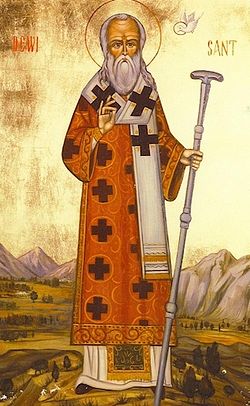 We went down by a steep path to the church, and the Dean, who is his own verger, showed us around it, saying as he pointed to a statue on the screen, first, in Welsh, “Dewi Sant Esgob,” and then “St. David the Bishop,” and so on all through, for there were many Welshmen among the crowd of pilgrims.
At the end of this most admirably conducted tour about the noble church, the Dean went to a place contrived in the wall of the choir aisle, and took a key and opened a small door. He put in his hand, and solemnly held up a pale fragment that had once been part of a man. It was part of the skull of Dewi Sant, the Bishop, who died more than twelve hundred years ago.
I noted one of the Americans in the party. She was gazing with a look of great amazement and slight amusement as the holy particle was held up. She had read of the relics of the saints, no doubt; but now she looked on a relic for the first time, and smiled, perhaps lest she might kneel.
We had accomplished our pilgrimage, but I hope we shall all go again. For, be it remembered, two pilgrimages to St. David’s are as good as one to Rome—bis dat menevia quantum.
The Apocrypha of the Apostle
There is no doubt that there was such a person as St. David, but strangely little is known about him historically. He was a great apostle of the Faith in western Wales, he presided over two synods, he died probably about the year 601, he was of such fame that churches dedicated to him—Llanddewi, or in English spelling Llanthewy—abound. Beyond that much all is conjecture.
He is sometimes called “Bishop of Menevia,” sometimes even Archbishop; but in the common implication of the terms, he was neither. The post-Roman Celtic Church had bishops, indeed, but no dioceses. They were bishop-abbots—though St. Columba of Iona was only in priest’s orders—and they ruled, primarily, over great congregations of monks; secondarily over the faithful in the neighbourhood of these monasteries.
The Fish and the Honeycomb
But though so little is known about St. David, legends are thick about his path. He said to have been, like Galahad in the Grail romances, illegitimate. His father saw, in a vision before St. David was born, a fish and a honeycomb, the fish denoting his “aquatic life,” while the honeycomb showed that he was “to hold a spiritual sense in a historical instrument,” as the honey in held in the comb.
The fish and the aquatic life are a puzzle; but there is a Llandowror, a church of the Waterman in South Wales, and St. Ilar, another Welsh saint, is styled Bysgottwr, that is, Fisherman. I am inclined to think that here we have a misunderstanding of the Fish sometimes carved on the tombs of ecclesiastics; the fish being Ichthys, a symbol of Christ.
The Mystic Altar
But the most significant of the Davidic legends is as follows. The Saint is said to have been consecrated bishop by the patriarch of Jerusalem, who gave him “a certain hallowed altar, in which the Lord’s Body had lain.” This altar was commonly called the Mystic Altar, and also the Gift from Heaven. “Never was this altar seen after the death of the saint by any son of man, but it lies hidden, covered in skins.” Thus wrote Ricemarch (Rhygyfrach), Bishop of St. David’s, in William of Malmesbury’s account of Glastonbury Abbey (1130). There it is called the Sapphire, and is said to have been lost for many years, till it was last recovered and brought to Glastonbury, which, as some say, is the Isle of Avalon.
Source of the Grail Romances
And the significance of the legend is this: that here, as I am convinced, we have one of the chief sources of the great romances of the Holy Grail. In these romances the shape of the Holy Vessel is indeterminate; the very phrase, “in which the Lord’s Body is lain,” being found in the earliest of them. In another the Grail appears under five shapes, the last of which was the chalice, and the chalice became finally the accepted form. But in the German “Parsifal” the Grail remains an altar, the Stone from Heaven, as St. David’s altar was the Gift from Heaven.
The Grail romances leavened the literature of all Europe. And I think we may trace all that is finest in them to that church by the roaring seas, far in the west.
Arthur Machen, the Pilgrim
by Christopher Tompkins
That Arthur Machen was a pilgrim would not surprise his readers. In the broadest sense of the word, Machen’s memoirs are testaments to his pilgrimages among hidden Welsh landscapes or the twisted streets of London. These wanderings were ecstatic adventures for the writer which reflect a cultural inheritance from his Celtic forebears.
Along the same lines, Machen’s residence at Melina Place became a destination for literary pilgrims. From England and the United States, men of letters, such as E. H. Visiak and Paul Jordan-Smith, journeyed to the small humble abode for vigorous talk and strong drink. These nights have become legendary and their retellings serve as mythic tales from a lost time. Other visitors, such as David Moss, requested itineraries from Machen with the aim to trace his life and writings by literally following in his footsteps.
However, as is the case in all things Machen, there is a deeper interior reality here. In its truest and most radical sense, Arthur Machen was a pilgrim,—one that undergoes an ascetic journey to a holy site for a spiritual end. The British Isles are holy lands where the saints still live.
That Machen was a Christian pilgrim should also not be a surprise. Such spiritual journeys are found in his fiction and each event prompts both crisis and change for the characters involved. To take one example, Ambrose Meyrick, the protagonist of The Secret Glory (1922), accompanies his father to saintly sites including the well of St. Ilar. The result is one of Machen’s most beautifully realized sequences. This miniature tour-de-force is followed by a numinous vision of the Holy Grail in a small cottage on the side of a wild Welsh mountain. At the book’s conclusion, Ambrose, on a pilgrimage to the East, is martyred—the ultimate ascetic act. Therefore, the result of his pilgrimage is salvation and sainthood.
Of course, this differs greatly with the “pilgrimage” of the unnamed girl in “The White People” whose explorations end in dissolution rather than glory. Let it be noted—there are dark pilgrimages and dark enchantments that mock the paradisaical. Throughout his work, Machen charts both paths to great effect.
In a more abstracted manner, The Great Return may symbolize a pilgrimage for the narrator as he travels to a small Welsh village in search of a miracle. That fictional village of “Llantrisant,” or Parish of the Three Saints, is based upon Tenby, the starting place of the pilgrimage that Machen details in the above article. This area of Pembrokeshire, which the Machens routinely visited on their holidays, also served as inspiration for The Terror and “Out of the Earth.” Paul Jordan-Smith recalls a visit to Machen during one such holiday to the region in which his host performed services as a guide as he did for the unnamed Americans.
Jordan-Smith reports: “Later the picnic party moved down to St. Govan’s Head and to the tiny chapel near at hand on the cliffside, St. Govan’s Chapel. Machen proclaimed St. Govan to have been Sir Gawain of the Arthurian Circle, and said that all the knights of the Round Table were originally Welsh saints who had later been transformed into men of armour by the Normans.” (1)
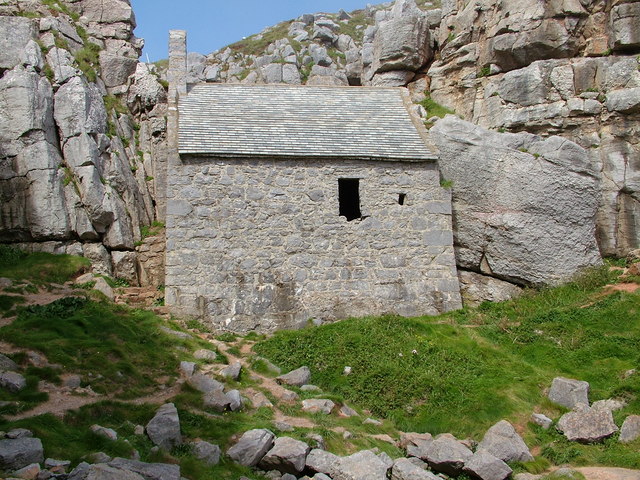
Indeed, Machen viewed the wandering Celtic saints as “monks-errant,” the source of the great Arthurian Legends that “leavened the literature of all Europe.” In notes he shared with A. E. Waite, Machen set out 25 propositions on the origin of the Romances that serve as a theoretical foundation for his approach to the subject in both essays and fiction. In a rhyme to Jordan-Smith’s recollection, Proposition 7 states: “Cadwaladr is Galahad.” (2)
If the knights of the legends are hieroglyphs of the Celtic Saints, what, in Machen’s schemata, is the Grail? We find that answer in Proposition 19: “The Grail is one of these ‘descents’: (a) Saint David’s altar given to him by the Patriarch of Jerusalem; (b) St. David’s Altar given to him by Xt Himself.” (3) With the 20th Proposition, Machen declared that St. David’s centrality is replaced by St. Joseph of Arimathea in the Glastonbury Legend.
Yet, for Arthur Machen, St. David remains central, not only as the Apostle to Wales, but to the Holy Grail by virtue of his Mystic Altar. From an early age, he knew well the saint’s name, as Machen grew up in the rectory of Llanddewi Fach, or Little St. David’s. Later, he cast the saint in The Great Return as one of three “Fishermen,” a designation rich in symbolism for its Christian and Arthurian associations. This appearance of St. David with the altar Sapphirus during “the Mass of the Sangraal,” the ecstatic climax of Machen’s entire body of Grail writings, illustrates his primacy.
In the journey to St. David’s, Machen followed the example of the great saint, one symbolically present in some of the writer’s best stories. “We had accomplished our pilgrimage, but I hope we shall all go again.” My hope is that this wish was realized.
Notes
1 The Arthur Machen Journal. Vol. I, Summer 1963, p. 25.
2 Faunus, The Journal of the Friends of Arthur Machen. Number 20, Summer 2009, p. 38.
3 Ibid., p. 39.


.jpg)


Thank you for this – fascinating (your commentary, with all its details, not least the additional Machen Arthuriana, as well as his article)! And, Gwyl Dewi Sant Llawen! – to you and any and all still in an appropriate time-zone. I was just wondering if St. David’s Cathedral had any relics of Dewi Sant (I could not remember, and had not yet tried to find out). My memories are sadly not very detailed nearly 54 years on from my visit there.
LikeLike
David, I visited in 2017. The shrine was restored in 2012, and according to information there in the Cathedral, at least some relics survived the Reformation and are contained in niches at the base of the shrine.
LikeLike
Thank you – I’m delighted to learn that!
LikeLike
Thanks Terry. I hope to get there one day.
LikeLike
Thanks David. I think a deep study needs to be made of Machen’s “Arthuriad.”
LikeLike
I wonder in what form(s) Machen knew William of Malmesbury’s De Antiquitate Glastonie Ecclesie or De antiquitate Glastoniensis ecclesiae – as I have seen the title variously given? John Scott’s The early history of Glastonbury: An Edition, Translation, and Study of William of Malmesbury’s De Antiquitate Glastonie Ecclesie was published by Boydell and Brewer in 1981. As to what was available to Machen, I see it is included in volume 179 of Patrologia Latina (scanned in the Archive) and the WorldCat lists a translation by Frank Lomax as The Antiquities of Glastonbury as published by Talbot in 190 or 1908 (and reprinted in recent decades), but I cannot find a scan online…
LikeLike
Oops! 1907!
LikeLike
Here’s the Archive scan:
https://archive.org/details/patrologiaecurs25unkngoog/page/n8/mode/2up?view=theater
LikeLike
Speaking of William of Malmesbury, I just saw an interesting richly-illustrated article of 4 March by Deacon Thomas L. McDonald entitled “Did St. George Exist?”, linked from his Weird Catholic substack, among those currently noted on the New Advent homepage. He has a nice quotation from a translation of William’s Chronicle (i.e., presumably, the Gesta regum Anglorum) about accounts of answered prayers at the siege of Antioch in 1098.
I am so pudding-headed, however, that I cannot certainly remember if, and if so where(-all) and how, Machen discusses William of Malmesbury in connection with “The Bowmen”…
LikeLike
I cannot recall Machen having written anything on Malmesbury in connection with St George. However, he did in connection with St. David: “St. David’s altar was, in the earlier legend, a gift from the Patriarch of Jerusalem, later it became a gift from heaven… So, when William of Malmesbury was ‘writing up’ Glastonbury Abbey (c. 1130, perhaps sixty years before the earliest of the romances was written) he speaks of St. David’s altar, known as Sapphirus, as one of the treasures of the place; lost for a long time and then recovered.” (Page 81-2, The Great Return, Darkly Bright Press, 2017.)
LikeLike
Fernand Cabrol’s 1911 Catholic Encyclopedia article, “Octave”, notes “The practice of having octaves for the feasts of the saints does not seem to be older than the eighth century, and even then it was peculiar to the Latins. From the ninth century it becomes more frequent.” This, then, historically at least, is a day within the Octave of St. David and upon it I have enjoyably discovered that one of the mysterious treasures in Eleanore Myers Jewett’s The Hidden Treasure of Glaston (1946), a historical novel for children set in the later Twelfth century, is none other than St. David’s Altar!
Lars Walker, re-reading it in the course of his ‘reading up’ for his novel on Hakon the Good, made me aware of this delightful book in a review posted on 25 February at the Brandywine Books site.
LikeLike