
The Weekly Machen
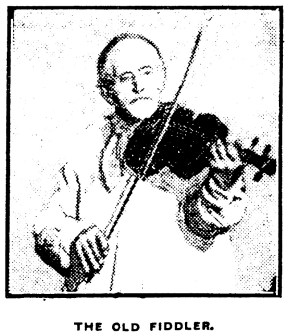
Here is a bit of curious esoterica that intersects music, literature and history. Arthur Machen writes with a sense of loss that is contagious. Though he condemns the gramophone, I wish the Old Fiddler could have been captured on it and preserved for those of us born after the passing of this great period in folk music.
In order to add emphasis to that last comment, forgive the following personal note. During Depression era Texas, my grandfather picked cotton during the day and played the fiddle for barn dances after the hot sun had set. When I was young, and he in his late eighties, my grandfather played a bit for me, and though I didn’t stick with it, the experience did inspire me to pick up the violin in elementary school. The sound of his playing, I seem to recall, was gentle, almost brittle, but no doubt, he burnt the strings while in his prime. He is long gone, and so is his music, and I wish I could uncover what happened to his instrument.
The opening verse is from Thomas Hardy’s “Friends Beyond.” The previously published article mentioned by Machen is “Thomas Hardy as Playwright,” (November 14, 1911), which will be posted next week.
Death of Thomas Hardy’s Old Fiddler
by
Arthur Machen
July 3, 1913
William Dewey, Tranter Reuben,
Farmer Laidlow, late at plough,
And the Squire and Lady Susan
Lie in Mellstock Churchyard now.
 There is a little-out-of-the-way paragraph in The Daily Mail this morning that will, I daresay, leave many readers cold; but it appeals to me.
“The death has just occurred in Whetstone’s Almshouse, Dorchester, of Mr. Harry Bailey, nearly the last of the old band of Dorset fiddlers who figure in so many of Mr. Hardy’s novels.” I knew old Harry Bailey, and I almost feel that with him there dies the old life of the English country-side.
About a year and a half ago I went down to Dorchester to see the celebrations in honour of Mr. Hardy’s birthday. The town laid its enchantments upon me as I entered it through dark avenues of leafless trees; still more when I stood on the height and saw the wild heath in the distance, vague and melancholy in the autumn twilight: the scene struck to the heart like sad music; here in the glimmering evening was all the magic of Hardy’s great romances as in a picture.
But most of all the incantation gained upon me that night when I saw the players rehearsing in the Corn Exchange. I wrote:
A very old man, who might almost have been a survivor from the Mellstock Quire in “Under the Greenwood Tree,” was striking his tuning-fork against the barrel, and screwing up his fiddle strings to the proper pitch. . . . They had put a smock over his black coat, and I thought it was strange that the old boy now wore as costume the habit which no doubt had been his customary dress in Dorset lanes and fields and on cheerful village greens for many a long year. . . . There is a last dance, and it was brave to see the old fiddler wagging his head in time with bow and elbow.
Apple-Cheeked Old Man
I found out that old fiddler Bailey was indeed one of the race of wandering minstrels. He had played all his life in country merrymakings; and now he was re-enacting at that country stage the scenes of the past days. I think, as the country folks danced round and round in the shepherd’s cottage—the play was “The Three Strangers”—that the fiddler forgot that it was all make believe; it was real for him, and the days and the years had gone back, and he was a young man again, and there was once more country mirth in Dorset.
I found him afterwards. He lived in comfort in Whetstone’s Almhouses, but it was his custom to stroll out every afternoon and enjoy a cup of tea at a coffee tavern. Here I came upon him, sitting by himself, fast asleep, his tea finished and his pipe on the table before him. He woke up at a tap on the elbow, and we had a talk. Old Harry was a little apple-cheeked man, cheery and pleasant, grown now a little dim with age, ready enough to talk about the old times, of the jigs and the songs and measures that were now dead and done with. The gramophones, he told me, pleased the people better now than the tunes that he could play on his fiddle; for the gramophones played the new tunes, and that was what people liked. And I said to myself: “The Lord have mercy on them!”
Smocks and Superstition
Harry Bailey corrected me in one particular. He had never worn the smock; he had been a townsman all his days; his father was parish clerk of All Saints, and he had played the violoncello there. But Bailey remembered the time when all the country folks wore smocks, and believed in witchery and many superstitions, and spoke in such a way that you yourself would hardly understand them; the way they speak in the play puts me in mind of the old talk.
I’ve known a woman that was thought a witch to be struck so as to make the blood come and break the spell; but the judge, he commented on that.
The fiddler came up to London a week or so later to bear his part in the Dorchester plays; I saw him again, smoking his pipe quietly and cheerfully by the fireside in a City hotel.
He had been in London before, when the Crimean War was going on.
And so old Harry is dead. With him, I am afraid, ends the old and goodly song of country mirth and music in England. They are all for the gramophone and the “pictures’’ now down Mellstock way.
Previous: Waiting for the Boat Train
Next: Thomas Hardy as Playwright
 darklybrightpress.com
Machen here is close to being a folklorist, a collector of vanishing rural ways.
What a book Machen might have written, before the Great War, if some publisher had paid him well to go into the country towns and sit and talk with the old folk in the taverns, marketplaces, churchyards, etc. Surely there’d have been some local clergymen who could have given him leads and maybe shared some traces with him. There would be plenty of details in Machen’s books about the beer and the food, when they were good. (We know he had that in him, to write well about such things — see his “Gary’s Inn Coffee-House,” though that is a wonderful London piece, not a rural reminiscence.)
A book that was never to be, but should have been, like (as I’ve imagined for many years) Coleridge’s poem about Nebuchadnezzar.
DN
LikeLike
Happily, some of the musical folklorists made audio recordings as well as transcriptions – a use of the gramophone of which Mr. Harry Bailey might have approved (though not so good as a living tradition!).
And, I wonder where Walter Starkie fits in all this? Wikipedia tells me he won a prize for his violin playing in the year this article was published, at age 18 or 19. He was classically trained – by Achille Simonetti pupil of Ernesto Camillo Sivori pupil of Paganini – but during his academic vacations travelled about having “Adventures with a Fiddle” (the phrase beginning the subtitle of each of three books recounting them, published between 1933-36), and recorded an LP entitled “Adventures with Gypsy Tunes” in the 1960s – uploaded on YouTube by his grandson, Simon Starkie.
LikeLike