
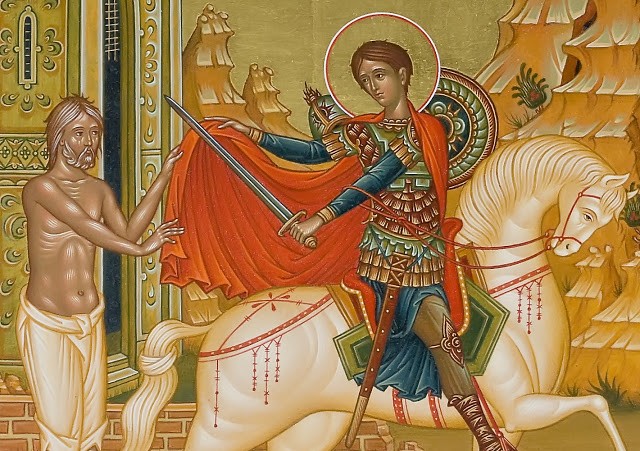
In signs and in miracles you were renowned throughout Gaul. / By grace and adoption you are a light for the world, O Martin, blessed of God. / Almsgiving and compassion filled your life with their splendors, / teaching and wise counsel were your riches and treasures, / which you dispense freely to those who honor you.
Introduction
St. Martin of Tours is a great saint who is remembered on November 11 in the Western Churches and on November 12/25 in the Eastern Orthodox Church. For many centuries in the West, his feast was widely celebrated as a high holy day with the singing of carols and the roasting of goose and other meats before commencement of the Nativity Fast. The traditions are rich and varied. This was one of many religious days that marked the seasons and by which communities were held together. Now for most of us, the feasts and fasts are gone, stripped away by secularism and atomization.
Are we the better off?
This essay by Arthur Machen comes from his excellent volume Dog and Duck: A London Calendar et Cætera (1924). Personally, it remains one of my favorite Machen books and I recommend reading it throughout the year as the subtitle suggests. In this excerpt, we discover a fine sermon appropriate for the feast. Unfortunately, Machen was more prophetic than he realized. How many vital things have we lost in the hundred years since he wrote the following words? The time has come to begin recovery.
Martinmas
by
Arthur Machen
In the infancy of photography, the artist with the camera was accustomed to say to his patients: ‘Smile, please.’ In those days one had to assume rigidity for a considerable time before the releasing ‘Thank you’ was uttered; and so it was no wonder that these frozen and prolonged smiles came out in a somewhat ghastly manner, and render many an old family album a terror and a wonder to this day. But this is beside the point. I merely recall the photographer of 1869-70, because I am reversing his favourite injunction. I do not say ‘Smile, please.’ I say: ‘Be so kind as to look grave.’ For we are to have a little theology.
It comes about like this. Somebody—I forget his name and the name of his book—has just written an amusing work about the eminent men of our age. He ‘takes them off,’ I gather, with a pretty wit, and dealing with Mr. G. K. Chesterton, gives a pleasant version of the Chestertonian doctrine; that no one without a bottle of Bass in each hand can enter the Kingdom of Heaven. And the curious thing is that he is evidently under the impression that he has uttered an extravagant parody of G. K. C., that he has reduced his position to an absurdity. Well, I cannot answer for Mr. Chesterton, but if I were he, I should accept the intended sarcasm as an admirable statement of my case; condensed, no doubt, and familiar, in its illustration, but all the better for that. Of course a man cannot enter the Kingdom of Heaven without a bottle of Bass in each hand. Advanced theologians, Modernists, Universalists and all that lot may hold that one bottle in one hand may just scrape a man past the gates, but I have never had much sympathy with what is called Liberal theology. But, surely, the supposed absurd and damaging overstatement is merely the most obvious and the soundest common sense. For, sinking the technical expression of the doctrine—I am afraid pure theology is apt now and then to degenerate into asperity, and I must not get cross in these calm pages—what reason is there to suppose that a good man is one who is devoid of a palate and devoid of a stomach; devoid, in fact, of senses of any kind? It having pleased Heaven to give its creatures these faculties of sense, why should we think that Heaven will be highly gratified by our behaving as if we had no such faculties? A man who blandly but firmly declined to admit that the sun was bright or the sky was blue, on the ground that good men never saw anything, would run the risk of being certified. Why should a man, who pretends that he can’t taste anything be thought to be a being of a superior caste? For, be it noted, I am not pressing the pro-alcohol side of the argument. ‘Bass,’ as I take it, means something good to drink, without reference to the fact that if you drink too much of that agreeable beverage you may be led to commit indiscretions. For the moment, I am willing to substitute for ‘a bottle of Bass in each hand,’ ‘an exquisitely made cup of chocolate in each hand,’ and that beverage reminds me of the story told by the great French gourmet, Brillat Savarin. That most sensible man, reviewing the Revolution from his special point of view, deplored the ruin that it brought to the monasteries and the convents. These, he said, speaking from experience, were the great schools of the last refinements in cookery, and he quotes the dictum of an Abbess of his acquaintance on this very subject of chocolate. ‘If you would have chocolate in perfection, my dear sir,’ said the religious lady, ‘if you would taste its most exquisite aromas, you must make it overnight and warm it up again the next morning; and I am sure that the good God, in whom reside all perfections, will not grudge us this little refinement.’ The Abbess was in the right of it. It is, of course, true that a really good man does not suffer his liking for a bottle of Bass or a cup of chocolate to make him neglect his mother, starve his wife, or send his children to the workhouse. If a good man has to choose between making the chocolate overnight and suffering the wife of his bosom to experience the pangs of want, he will, almost always, say: ‘By all means make it in the morning; I can bear it.’ But this is true of all delights of the senses; a really nice man will not suffer his family to come to grief in order that he may indulge his propensity for looking at sunsets.
I said that we would waive the more or less alcoholic side of the question as involved in the symbol, ‘Bass,’ selected by Mr. Chesterton’s critic. I said so because I think that good drink merely represents the first line of the cause which the bad people are attacking. It is my opinion that these bad people are only in the first stage or movement of a much more general attack. Tobacco will be the next line, the next engagement will centre round the meditative pipe, the gay cigarette, the magnificent Corona. Already that battle is preparing in America; soon, in powerful circles, a pipe will be inconsistent with piety. Nor will matters stop there. The Vegetarians have long been aware that what is the matter with the world is Meat. They have their feelings, like the anti-Burgundy and anti-Bass people and the anti-Tobacco people. They are quite convinced, with Mr. Bumble in Oliver Twist, that Meat is the root of all evil.
‘It’s not Madness, ma’am,’ replied Mr. Bumble … ‘it’s Meat.’
These persons then, sharing the opinion and the intelligence of Mr. Bumble, will engage on an anti-meat campaign. If they win, they will divide into two parties. One set will allow us to cook our vegetables; the other side will insist that if you are to boil your green peas, you may as well dine off rumpsteak at once. And, of course, sham science will come to their aid. There are plenty of doctors already who are quite prepared to demonstrate by unanswerable arguments that if you cook anything you destroy all its value. Before long there will be letters in The Times over signatures furnished with the most appalling array of degrees and qualifications showing that the way out of all our difficulties is to put out the kitchen fire. [1] But it would be a great mistake to suppose that the campaign will stop here, with our palates and stomachs and general comfort and well-being. All the arts will next be the object of attack; tobacco, beer, beef and boiled beans having fallen, painting, sculpture, music, literature will be suspected, examined, denounced, prohibited. This is no fantasy; for this has happened before. It happened in the sixteenth and seventeenth centuries, and is generally known as Puritanism. The movement was then allied with certain theological views. It began by smashing and destroying all the beautiful things that were then to be found in churches. It blotted out of the world a mass of beauty in a manner which is really awful to contemplate. Macaulay, not by any means the acutest of critics in a general way, got to the heart of the matter in his account of the Puritan objection to bear-baiting. They disliked bear-baiting, he said, not because it gave pain to the bear, but because it gave pleasure to the spectators. So with their objection to sports and games of all sorts. They began by saying—and, no doubt, believing—that games were wicked when played on Sunday. They ended by banning games and sports of all kinds on any day. They shut up the theatres: they gave pleasure, and the Puritan hates pleasure because it is a good thing.
Now at the end of this grave sermon, I will give my text, reserving it, contrary to the usual practice of sound divines, to the last. This is the month of November, and on the eleventh of November is the feast of St. Martin, that good soldier-saint who gave half his cloak to the shivering beggar. And in the old days they used to say:
On the feast of Martinmas
Cups of ale shall freely pass.
They knew in those days that the saint and his charity and good ale were all good together, each in its several degree. They knew that all three were ‘congruous.’ They knew that a man cannot enter the Kingdom of Heaven unless he carries a bottle of Bass in each hand.
Footnote by Arthur Machen
[1] I was a true prophet. The above was written in 1921. Now, in 1923, I have just been reading the report of a lecture by Dr. Leonard Williams, a well-known Harley Street specialist. Dr. Williams declares that the kitchen range is the worst enemy of man, and that we ought to live on raw roots and things, and very little of them. Compare with this the system of another distinguished specialist, Mr. Squeers, of Dotheboys Hall, Yorkshire. ‘When a boy gets weak and ill and don’t relish his meals we give him a change of diet—turn him out for an hour or so every day into a neighbour’s turnip-field, or sometimes, if it’s a delicate case, a turnip-field and a piece of carrots alternately.
 darklybrightpress.com
“They have their feelings”, “They are quite convinced,” “And, of course, sham science will come to their aid. There are plenty of doctors already who are quite prepared to demonstrate by unanswerable arguments […]”: “I was a true prophet” – indeed! And, “Advanced theologians, Modernists, Universalists and all that lot” and “what is called Liberal theology” have perhaps even outdone Machen’s prophetic imaginaton – and “most obvious and […] soundest common sense” – as to what “will be inconsistent with piety”.
LikeLike
Your St. Martin liturgical music reminds me to mention a living but variously sometimes still very much Christian and sometimes thoroughly ‘interreligious/secularized’ folk celebration here in the Netherlands and in Germany, with evening processions/parades with folksongs of the feast and lanterns (usually paper, but historically vegetable in some places), and huge bonfires, and begging door-to-door (lots of Mars candy ads online at the moment!)
LikeLike
Interestingly, there is a video on YouTube with one of the songs in dialect (I have an edition of songs in various dialects) with images which it identifies as from 1924 – the year of Dog and Duck! – and 1939: it is entitled
Sintermertes veugelke (Venlo)
on the channel Venlo Wiki. I’ve never seen those tins with burning coals in action, though they remind me of some fancy (Anglican!) thurible work I have seen… I don’t know who St. Martin’s companion / assistant is, but we have a cake form of St. Martin so robed riding a horse – which doubles for St. Nicholas. The processions / parades often have someone in Roman military dress riding a horse, and you can find various costumed actings-out of the episode of St. Martin and the beggar, in and out of Churches on YouTube.
As with various English nursery rhymes, it is often the question what is going on in these songs (cf. Machen’s “Shakespeare’s Nonsense”!). This begins something like ‘St. Martin’s little bird has a red noddle, and a blue tail, whoopie St. Martin” with the third line noting that today is the Feast of St.Martin of Tours and tomorrow the Feast of the martyred Pope St. Martin (who suffered together with St. Maximus the Confessor) but it does this by way of referring to Pope St. Martin as “Sinterkrökke” – a “krökke” being a chair or stool without back, here indicating The Throne of St. Peter! (A couple versions of the text are in the Limburgs version of the Wikipedia article, “Martin of Tours”.)
LikeLike
Here is a link:
LikeLike
Thanks for the video and your firsthand experience of the holiday in Europe. In America, the feast virtually unknown. Perhaps, it is still celebrated in some form in the Latin world as well.
LikeLike
Thanks – and a good thought! I found a separate Wikipedia article, “St. Martin’s Day”, with an assortment of national /regional detail, though not so much southerly – but with a note as to 39 articles in other languages! The French, Spanish, and Portuguese ones do not strike me as having much, but the Italian one seems detailed (though I have not run any of them through the Google translation thingy, or any other…).
LikeLike