
The Weekly Machen
Margate is a seaside town in the county of Kent. It is to that sunny spot that the Evening News sent Arthur Machen for a story about early holidays over a century ago. During his tenure at the paper, Machen regularly holidayed on the other side of the country in Pembrokeshire, Wales. No doubt, he preferred that locale to an English beach destination, but he reported feeling refreshed by the pleasant atmosphere, one that remained quiet from the lack of crowds on a spring before the beginning of the Great War.
Moods at Margate
by
Arthur Machen
May 12, 1914
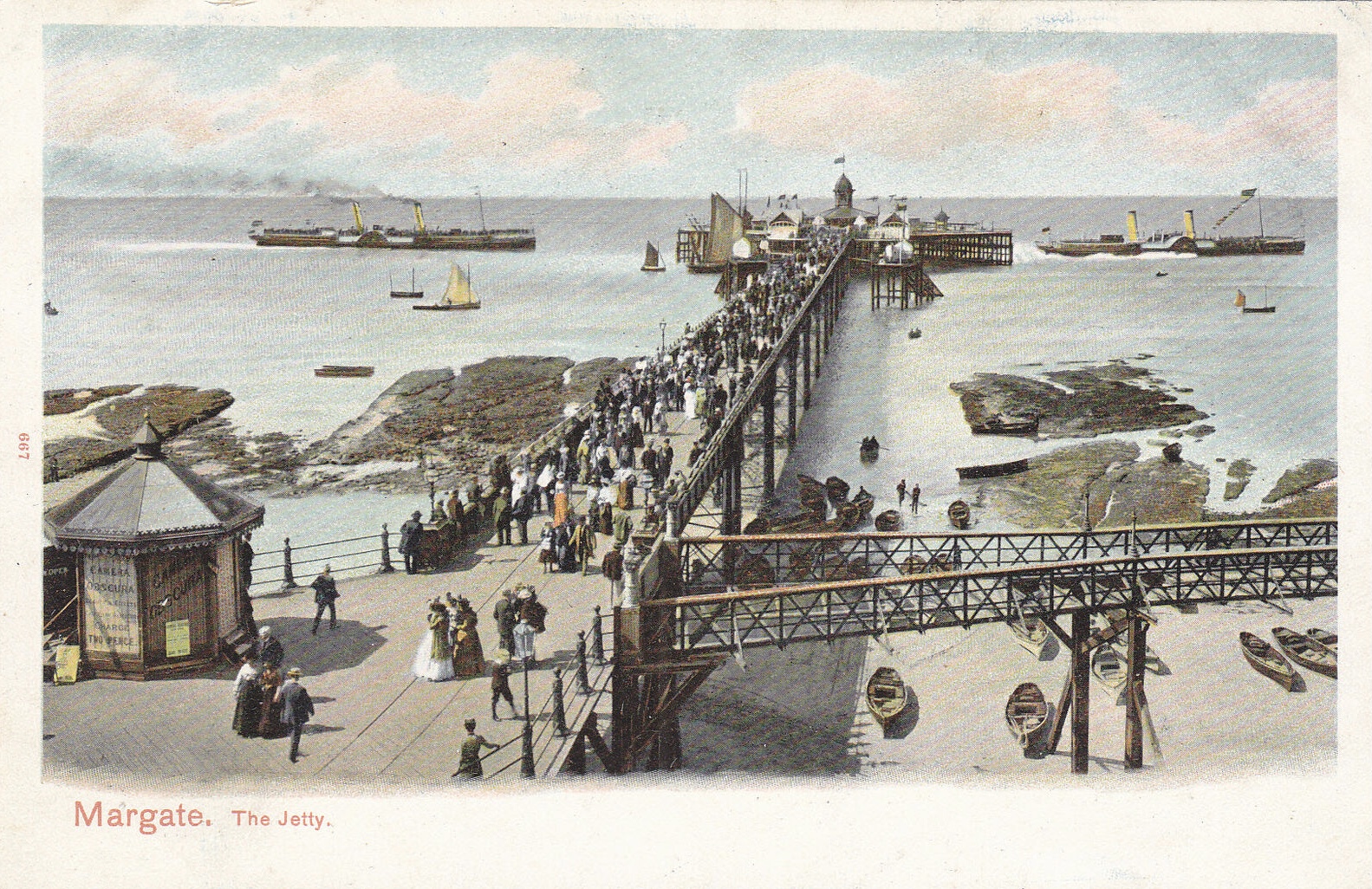
MARGATE, Monday night.
Well, I got to Margate at last, and when I got to it I liked it very much.
I have seen the place under curiously different aspects. Nearly two years ago on a flying motor tour, I dropped into town at ten o’clock on the morning of the August Bank Holiday. It was that unhappy year of miserable summer rain of 1912, and flying showers were scudding along the coast. Yet, in spite of the early hour, in spite of the bleared sky and the windswept rain, the sands were black with people. They swarmed like ants from the station to the jetty, and as I passed through fresh trains arrived, denser multitudes poured on to the shore.
Then there is a longer memory of Margate; of Margate late in September, dim and misty and empty, a Margate grave and Georgian, that might have been called Bloomsbury-on-Sea. It was pleasant but somewhat forlorn; it was a thought too evident that the great revel of the year had been and was done, and that now was the morning after the feast. The solitude of the wood and of the mountain is always admirable; but Margate at the end of September had more of the solitude of the shut-up market-place.
At Its Best
The other day, I think, I found the place at its best. While London, as I hear, was shuddering under grim, cold skies, here was the radiant blue, and great white clouds, like noble, wind-swelled galleons, went sailing slowly over it. The breeze blew, with life and vigour and refreshment for the weary in its breath; the sun shone warm on the yellow sand, on the cheerful folks—not too multitudinous—who were strolling up and down on the sea front.
And a glance showed one that the season had begun. Not the season as it is in August; there were no congested, swarming myriads of people; but just a pleasant sufficiency to keep one in touch with life. The streets were filled, but not too full; and on the sands, where the sun shone warmest the children and their friends had gathered in quite a goodly fashion. Here were the usual sports and pastimes and occupations of the seaside; donkeys were trotting up and down, sand-castles were being built up with painful architecture of the wooden spade, the elders were lying back peacefully in their canvas chairs, and odd games were going on. I noted one, it was played with four cricket stumps and a football. I could not make out the rules—I am not an authority on sport—but I should think it must have been Crickball.
Seaweed and Sunshine
I strolled up and down the front and inhaled brave seabreezes on the jetty and enjoyed the seaweed odours—I always feel that I am being [illegible word] at the sea if there is not plenty of that seaweed smell, strong, and rich and thick—and somehow between seabreeze and seaweed and genial sunshine the last symptoms of that something which was not, of course, influence, and yet felt remarkably like it, vanished away. My knees became knees again, not like retired jelly-fish; I was getting distinctly hungry; and my thoughts were diverted from the contemplation of the silent tomb.
I found myself, indeed, taking an extraordinary relish in the old house and quiet streets and leafy squares of old Margate. Down by the jetty I noted old houses with two tiers of dormer windows in their roofs; not a common circumstance in English building. I wandered up by Cecil-square and saw with satisfaction the date 1769 on a corner of it; 1 was pleased by some interesting George III. fanlights, by ornaments of urns and garlands of the Adam period, by some very dignified porticoes.
Now is the Time
And there are eighteenth century bow-windows and box-windows of excellent merit, and some Georgian shop-windows with small, square panes of glass, of the kind that is getting very scarce in London. And to the best of my belief I marked in the old town the curves of an early seventeenth-century gable; a thing to me almost as refreshing as the kindly wind from the sea.
And, on the whole, I am quite clear that if anybody wants to go to Margate at all, now is the time to make the journey; the place is at its best. Unless it is absolutely a condition of your holiday happiness that you are one of an immense horde of your fellow creatures, unless you must struggle for a small portion of sand to sit on before you can feel really bright, unless a costly garret with a fine view of the chimney-pots is of the essence of your joys, now in the season of lengthening days, of sunlight that is genial without being too hot, now is the hour of the wise holiday-maker.
And I found that as a matter of fact many other people had come to this conclusion.
The First Habit
“There is a steadily growing tendency to come early,” said one resident. “I have noticed it during the last three years, and each year brings people earlier to the place. Last June, I remember, there were more visitors than I have ever noticed before at that time, and now, though it is early in May, a steady stream is setting in. The fast trains are packed every day.”
“Formerly,” said another Margate man, “the place was empty from the middle of September till the end of June; now people are finding out that this is the time to get the benefit of the Margate air, and to get it in comfort at moderate prices and without overcrowding.”
And the proprietor of a well-known hotel, where you can dine on a sunlit terrace, right above the sea, was quite clear as to the increase in his early visitors.
“Every year I get more people at this time and from now onwards. Of course, it’s quite the best time in the year—the place is overcrowded in the late summer. And I think the flat habit has a good deal to do with the early and occasional holiday; it’s much simpler to shut up a lot than to shut up a house.”
Previous: Talks About Books
Next: The Calvary at Azay
 darklybrightpress.com
This was delightful! I’m torn between curiosity and dread as to what it’s like, now…
I was struck by “I noted one, it was played with four cricket stumps and a football. I could not make out the rules—I am not an authority on sport—but I should think it must have been Crickball.” I went looking, and there seems to be at least one real game/sport now called ‘Crickball’ or ‘Cricball’ – but it seems also to be presented as fairly new. The New English Dictionary from Machen’s day, neither ‘C’ volume nor 1930 Supplement, has an entry, though ‘Crick’ is noted as “Short for Cricket”. Is Machen perhaps the coiner of ‘Crickball’ (whether (m)any its current practitioners are aware of that, or not)?
LikeLike