
The Weekly Machen
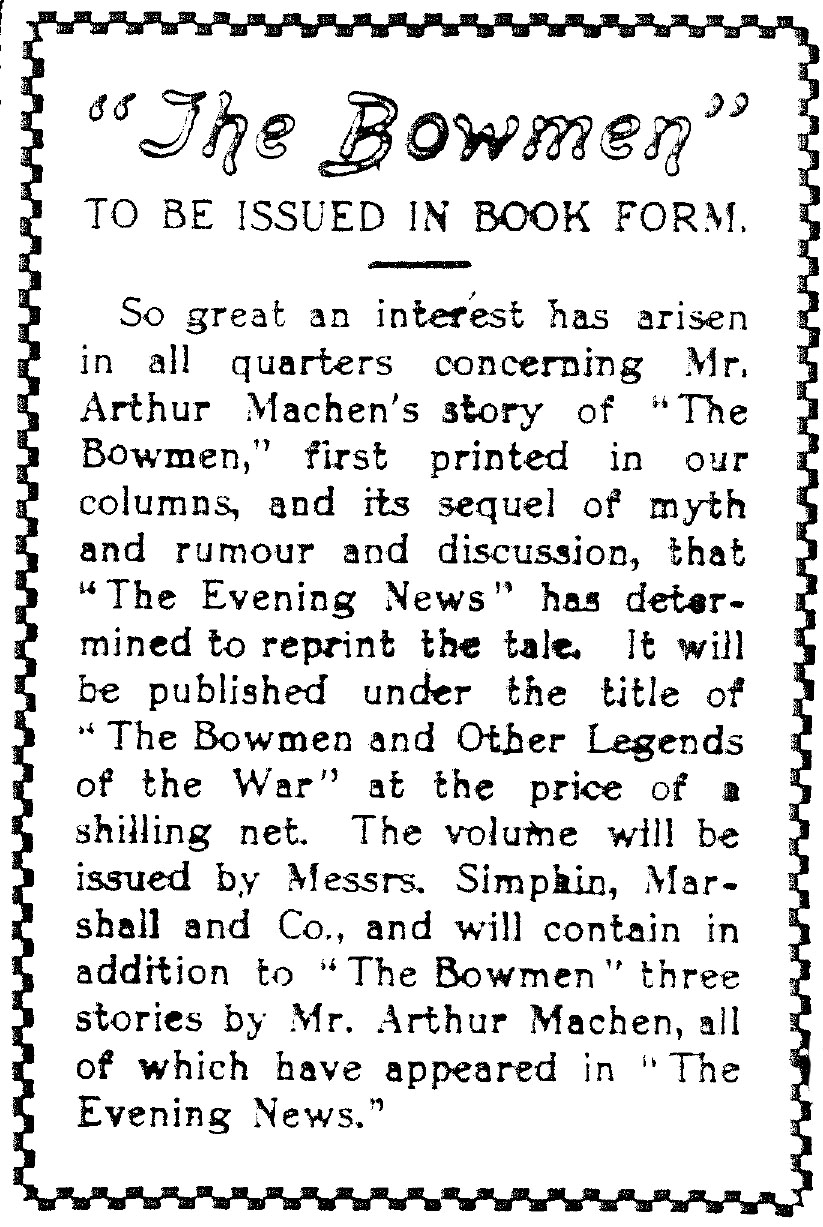
The Evening News had published “The Bowmen” in the autumn of 1914, and by the following summer, the Angel of Mons controversy had reached a fever-pitch with dozens of articles and pamphlets addressing the topic. This week, we present one of many contrarian responses from Arthur Machen. An advertisement for the then-upcoming publication of Machen’s short story collection is included.
No Escape from The Bowmen:
My Sympathy with Frankenstein
by
Arthur Machen
July 30, 1915
Frankenstein made a monster to his sorrow. I have forgotten what happened to this unfortunate inventor in the end: but I begin to sympathise with him, though my creation was a more benevolent kind than his.
To sympathise; since the ghosts that I raised refuse to be laid or to depart. The excitement about the “Angels of Mons” seemed to be intensified daily; it will soon be necessary to reserve a column, headed, “The Angels Day by Day.”
To begin with the morning paper. The Daily Mail prints a letter from a correspondent, who signs himself A. A. R.
A. A. R. quotes an article from Bladud, a Bath journal, called “The Angelic Guard at Mons.”
In this the daughter of a well-known canon states that she knew two officers, both of whom had themselves seen the angels which saved our left wing from the Germans. One of these officers said…
I do not think it is necessary to go further into what the officer said. First, because the evidence, on its face, is third or fourth hand, and therefore no evidence at all. Secondly (but chiefly), because the “daughter of a well-known canon” is Miss Marrable, and Miss Marrable has written to the editor of The Evening News denying all knowledge of the matter.
A. A. R. goes on to say:—
The officer swore he saw the angels. I should like to ask Mr. Machen whether he invented this account? A circumstantial and detailed narrative like this, if untrue, can only be met in two ways: (1) By charging these officers with deliberate lying; (2) By suggesting that they were the victims of hallucination. Personally, I cannot accept either of these alternatives, etc., etc.
This is how we reason in this “rational” age of ours. A. A. R. argues about the anonymous “officer’s” morals and psychology, forgetting that the very existence of the officer is yet to be proven.
And there is some queer “reasoning” in a little pink pamphlet which I have received this morning. It is called “Wonderful Works of God: a Ministry of Angels.” I gather it is being circulated by a clergyman at the price of 3s. 6d. a hundred, 1s. for 24, or 1d. a single copy.
It quotes various authorities. The Rev. J. J. Luce says that he believes the British Army at Mons was saved by Divine Intervention. Mr. Luce’s belief is pious, but not to the point.
Then Mr. Ben Tillett testifies:—
No military authority, French, German, or British, is able to explain, why the men who got through Mons were not annihilated.
This interesting; it raises a question; but it does not answer it.
Miss Marrable’s Hearsay
And then Miss A. Marrable, daughter of Canon Marrable, says [it is not stated where or to whom]:—
I have no reason to doubt the story of the “Vision of Angels” being true, as I have heard it from various quarters.
Now this is interesting. Miss Marrable, as has been stated, has written to the Editor of this journal denying all knowledge of the subject. But it is possible that she may have said something like what she is represented as saying in the pink pamphlet. For she introduces her statement not with the phrase: “An officer told me,” but with the very different phrase: “It has been said, ‘Some miracle must have happened,’ etc., etc. It is a fixed principle that on dits are not evidence!
So what it amounts to is this: Miss Marrable has heard the story— as we have all heard it— and sees no reason to doubt it. And the fact of Miss Marrable’s hearsay—common to us all—has been used as the sure foundation, the certain, convincing evidence on which the whole tower of rumour has been built! It is nothing less than amazing.
Then— to continue with the Pink Pamphlet— there is a paragraph headed “Truth or Fiction.”
What Churchmen Should Believe
It begins by assuming the existence of “testimony to the existence and interposition of angels given by British soldiers under fire.” There is, so far, no evidence whatever that any British soldiers have given any such testimony.
Then the writer, after assuming the existence of these testifiers says, “Not one of these men states that he had read or heard of Mr. Machen’s interesting novel.” So the bit of a short story, hardly filling a column of The Evening News, has now become a novel. And so—to quote again—“one witness to a fact is worth a hundred imaginations of a novelist.” True, indeed; but there is no novel in the case, and the “one witness” has not yet been produced.
Finally, it is stated that “Every good Churchman ought to believe in the ministry of the Holy Angels.” I cordially agree with that proposition, but I would point out that it is not identical with the proposition that “every good Churchman ought believe in all the idle gossip that he hears about the ministry of the Holy Angels.”
And it is that latter proposition which seems to me to be in the writer’s mind.
Previous: Some Novels of the Moment
Next: Sixty Years of Photographs
 darklybrightpress.com
Machen’s predicament reminds me of Tolkien’s dismay regarding fans of The Lord of the Rings who, he believed, became obsessed with it in an unwholesome way.
LikeLike
Very interesting. I know too little about that.
LikeLike
Thank you for this!
Miss Marrable, courteously anonymized, seems to have been included in the book here advertised. On page 24, Machen writes “A lady’s name has been drawn, most unwarrantably as it appears to me, into the discussion, and I have no doubt that this lady has been subject to a good deal of pestering and annoyance. She has written to the Editor of THE EVENING NEWS denying all knowledge of the supposed miracle.” The only Canon Marrable I can find is William, with his life-dates given as 1821-1906. Interestingly, Simpkin, Marshall and Co. published his book, Family Prayers for One Week in 1873. I see that David Clarke, in The Angels of Mons: Phantom Soldiers and Ghostly Guardians (2004) has a number of references to Miss Sarah Marrable. WorldCat tells me that the National Library of Scotland has a copy of “Wonderful Works of God: a Ministry of Angels”, but has almost no further details – though it does list its length as four pages.
LikeLike