
The Weekly Machen
Don’t allow the banality in the title of the following article to trick you into skipping it. True, Arthur Machen was often given assignments which could be described as hackwork. However, time and time again, I have found our great stylist transmuting the ordinary with a wonder of mystery. This weekly column is full of examples of Machen working his literary power on vegetable stands, flower-shows, hop gardens, and now… poster stamps.
Our Poster Stamp Competition:
A Glance at the Designs
by
Arthur Machen
April 29, 1915
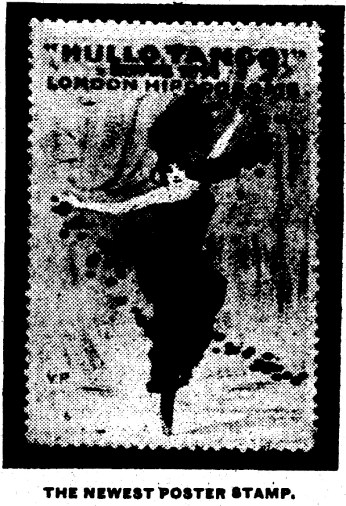 On Friday next. May 1 The Evening News, Poster Stamp Competition will be closed, and soon after judgment will be given as to who has sent in the best design and won the prize of twenty guineas.
And I have been looking at sheaves upon sheaves of stamps, and wondering not a little at this new art form. For your true, ideal poster stamp is a paradox; it is a conjuring of the huge into the compass of the minute. An ox in a teacup, the ingenious advertisement makes boast; and here in the poster stamp you conjure your bold and broad effects, displayed on twenty feet of wall space, into the dimensions of a miniature. I believe Doré would have excelled in this new way of art; for he revelled in vast aerial perspectives, in huge theatrical canvases; and yet in some of the drawings in the Contes Drolatiques he has pictured vastness in thumbnail limits.
But what is a Poster Stamp? It is a design which may be affixed in the adhesive fashion of the common stamp of the post office on any document or letter, on any bill, warrant, quittance or obligation, I suppose, which a firm or an individual may issue or utter. Its end is the end of the big poster; that is advertisement.
Mr. Hassall, the prince of poster-artists, predicts that firms now unknown may likely enough become famous through their striking and original poster-stamps. Why not?
The house of Pears emerged from an obscure existence of almost a hundred years by means of “Bubbles”; and I see no reason why some honest little bookmaker in a back street should not become illustrious through a stamp bearing the design of the seven-leagued boots in blue and gold and scarlet.
Germany as Pioneer
The invention of the new form belongs, I believe, to Germany. Mr. Hassall says that he designed a stamp for a mustard firm seventeen years ago, but Germany had its decorative stamps as early as 1894. The antiquaries of the subject, who have pierced into tho dim mists of twenty years ago, say that of old time in Germany—that is up to the ‘seventies of the last century—all letters had to be sealed with wax. Then, an imitation seal, made of paper, was allowed, and as the wax had often borne impressions of coat-armour, monograms, and such devices, so the substituted paper seals in due course received design and decoration.
Philanthropic societies adopted some significant device on their seal, patriotic leagues saw the benefit of the idea, large business firms perceived the new and sweet use of this advertisement. So the paper seal was transmuted with the poster stamp, and now there are poster stamp exhibitions—the first was held in 1909—and a new philately has arisen. The stamps are collected and bought and exchanged. The eager sportsman will chase all over the Continent for a specimen of that rare Schmidt issue of 1906—the famous stamp that shows the blacksmith at his fiery forge—and there are great tales of the unique Rugen; a golden Venus rising from the blue waves of the North Sea.
Art and Advertisement
It is The Evening News, I am glad to say, that has brought this most commendable fashion into England. Commendable, because it is going to benefit so many sorts and conditions of men. The man of business will not be slow to find out the benefit of this novel form of advertisement. Advertising is becoming a well-established artifice; but whereas once it was only necessary to shout loud enough, now the shout, if it is to be effective, must be something of a song. Advertisement must have art in it. A novel and excellent form of advertising is certain to attract a new public. There are many people whom the large appeal of the polling station leaves indifferent; they will be captured by these tiny square inches of curious design.
Then the poster stamp will provide the artists with a new field, and a field for the exercise of their nicest ingenuity. Mr. Walter Crane, for this very reason, has the warmest welcome for the new form; he has noted how few are the opportunities in England for the work of good designers. Add to the list of the benefited the mystery and art of colour printing; and perhaps the chiefest joys of all will fall to the great tribe of the collectors, with whom I always sympathise, whom I always envy, though I have never had the patience to collect anything myself.

Dome of St. Paul’s
But think of the novel delights that await these admirable men, the hunters of rare things, the people who go through the world always on the lookout for some desirable object that may evade them for years—and may suddenly be presented to their thirsty eyes as they cross the road in Islington or take a short cut down Putney way. The Evening News is getting ready poster-stamp albums for these ingenious and happy and deserving folks.
As I have said, I have been looking through the hundreds of designs sent in for the twenty-guinea competition. The best, I think, are those which have been done on the lines laid down by Mr. Walter Crane; that have adhered to simplicity and to a certain heraldic form of decorative art. Many, of course, have gone astray by being pictorial, by forgetting that the poster stamp is really a poster painted small. But what struck me chiefly in the collection was the immense popularity of the Dome of St. Paul’s. I believe that the dome appears in fifty per cent. of the designs. It stands out, black, against flaming sunset skies; it is a pink dome rising into a purple heaven, it is in gold upon a blue sky, it is green under a silver moon, and black again, as a great flaming scarlet sun sinks in the west. The Dome of St. Paul’s is combined with owls and bats and stars and telephones and telegraphic wires; it looms vast over all the Poster Stamp Competition.
Previous: An Exploration in Dickens’ Land
Next:
 darklybrightpress.com
“Mr. Hassall” must be Machen’s contemporary John Hassall (1868-1948):
https://en.wikipedia.org/wiki/John_Hassall_(illustrator)
He was the father of engraver Joan Hassall (1906-1988):
https://en.wikipedia.org/wiki/Joan_Hassall
Joan Hassall designed the dust jacket for poet Ruth Pitter’s collection Urania, which I regard as perhaps the most beautiful dust jacket of any of my books. Examples of her art may be Googled. They are pleasing indeed.
Joan’s brother was Christopher Hassall, a poet whose work was appreciated by C. S. Lewis. I expect to read him one of these days.
It would be interesting to know if Machen spoke to Walter Crane. Crane drew the lavish pictures for an illustrated edition of Spenser’s Faerie Queene. Dover reprinted the drawings in a paperback edition. Whenever I read part of The Faerie Queene, I like to have the Dover book at hand as a companion.
LikeLike
I want to read Christ’s Comet: The Story of a Thirty Years’ Journey that Began and Ended on the Same Day (1937), Christopher Hassall’s Canterbury Festival play! I enjoyed his S.O.S. Ludlow (1940), which Lewis quotes in That Hideous Strength (the whole volume of three poems is enjoyable).
LikeLike
Everybody visiting this site likely pronounced Arthur Machen’s surname correctly already, but Doug Anderson has found a rare book in which AM spells it out for us. The same book also records Tolkien’s own statement about his name.
http://ashiverinthearchives.blogspot.com/2023/07/how-to-correctly-pronounce-names-like.html
LikeLike
Fascinating – and, whew: I’m only 2 out of 5 on those! Wikpedia says (with “citation needed” note!) “Jones had adopted his wife’s maiden name, Machen, to inherit a legacy, legally becoming ‘Jones-Machen'” – what do we know about Machen’s mother’s Scottish(-descended?) family? I always assumed it was “mayken” – and unrelated to Welsh ‘mochyn’ – still part of an insult in my immigrant-Welsh-descended family branch (‘mochyn drwg’: ‘bad pig’!) – though one wonders which of the Jones-Machen contemporaries may have made their lives unpleasant playing on that.
LikeLike
Finally got around to see where the surname Machen might come from, especially as Scottish – with a simple online search encountering all sorts of suggestions (none of which I have followed up, yet) suggesting it is a variant of ‘Mason’! Wondering about a possible ‘Mac+hen’ (or some such), I find nothing obvious in the Wikipedia article, “List of Scottish Gaelic surnames”, though MacEanraig, MacEanraig are connected with Henderson, Hendry, Henry, MacKendrick.
LikeLike
Thank you: this was very interesting – and new to me (much as I enjoyed, e.g, ‘sticker-books’ in my youth, which I presume are indebted to this)! It seems still to be going strong in its ‘self-adhesive sticker’ descendant(s) – I saw one today (was it on a lamp post?) bearing the inscription ‘I [heart-shape] MIR’, and wondered which/what – ‘peace’, ‘the world’, both (as in the Church-Slavonic blessing), or any of the various things I find in Wikipedia’s “Mir (disambiguation)” – or something else again?
LikeLike