
The Weekly Machen
Several installments of Machen’s long running series, “Odd Volumes,” have appeared as part of The Weekly Machen, but below, we present the debut article of this column from the first year of Machen’s tenure at the Evening News. Among other things, Machen reviews a critical volume on Poe and criticizes a novel by Algernon Blackwood. More of his thoughts on Blackwood’s work have been posted elsewhere. The reader will find a couple items appended which followed Machen’s column in the original newspaper edition. It is not currently known if Machen read and reviewed any of these “newly-received books.”
Odd Volumes:
Stray Notes on Some Books of To-day
by
Arthur Machen
October 10, 1910
I have been waiting with some anxiety for the appearance of “the” book of the autumn season, but so far the chase has been unsuccessful.
Literature, like corn and hops, has its good years, its “average crop” years, and its thoroughly bad years. So far, 1910 must be ranked as average.
There are lots of new novels, of course, but I don’t think that the most optimistic surveyor of the literary world would say that anything approaching a classic is to be formed amongst them. Mr. De Morgan has turned his attention to “costume” work, and everybody seems to wish that he wouldn’t do it.
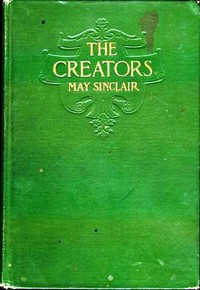 Miss May Sinclair has never come close within measurable distance of her first book, “Mr. And Mrs. Neville Tyson.” Her last novel, “The Creators,” is an intensely tiresome study of a group of intensely tiresome literary people.
And here, I think, we have an example of the importance of the “point of view.” If Miss Sinclair had treated her pompous novelists, male and female, as comic characters, “The Creators” might have been most entertaining. There is always a wealth of quiet fun to be obtained from people who speak and—and speak constantly—of their own “genius.”
Mr. Algernon Blackwood has hardly done himself justice in his last book, “The Human Chord.” This is a pity, as Mr. Blackwood has achieved some work which is very fine indeed. The stories in “The Listener” and in “John Silence” will always have a place in any collection of “Tales of Horror and Mystery”; and there is one study of solitude (in the volume called “The Lost Valley”) that haunts the mind with its suggestion of loneliness made manifest: of the awful spirit of the waste places taking on a form which may not be tangible, but certainly brings about tangible effects.
 But Mr. Blackwood’s greatest successes have been in the region of vague terror, in enlarging on the emotions that we all feel in solitary, untrodden spaces. “The Human Chord” is not vague; it is definite—nay, it is technical. It is built up on a whole series of propositions derived from “occult science”; it depends upon a theory of the vibration of sounds, linked with another occult (and very ancient) theory—that if you know the true Name of any being you can control that being. I believe savage chiefs of to-day have their sacred names, which are kept secret; and the true name of Rome was said to be known only to the priests. The notion was that if the enemies of Rome knew its Name, Rome itself would be helpless at their feet.
I do not say that such theories as these cannot be utilised in the writing of romances, but I do say that “The Human Chord,” in spite of some great moments, is not Mr. Blackwood at his best.
While we are talking of tales of mystery, it may be well to note a new book on Edgar Allan Poe.
Mr. Ransome, the author of “Edgar Allan Poe: A Critical Study” (Secker), points out, practically, that Poe is a man with two reputations. The ordinary reader knows him as an inventor of the terrible and mysterious, as a purveyor of “shockers” of a very high order of merit. But there is another, and a much smaller circle, that reverences Poe as an æsthetic critic: it is to this small but dedicated band that Ransome appeals his well-reasoned and well-written book.
The fact is that Poe was a many-sided man. He was, as Ransome insists, one of the finest of æsthetic critics; he was unmatched as a dealer in physical horror; he invented the story of Voyage and Adventure; he invented (in literature) the cryptogram; and, above all, he invented (in his character of Dupin) the analytic detective, who is familiar to most of us under the name of Sherlock Holmes; and, at its best, the poetry of Poe is of quite supreme excellence.
France is the country of gigantic literary undertakings. To begin with, there was Rabelais, who devoted the best part of his life to writing the Five Parts of Gargantua and Pantagruel. Then Balzac had the immense inspiration of the Comedie Humaine; the whole contemporary life of France mapped out and marshalled in a series of astounding romances. A similar idea, plus the doctrine of heredity, was no doubt in the mind of Zola when he thought of the family whose members figure in so many of his books; and the last of these novelists on the gigantic scale is M. Romaine Rolland, author of “Jean Christophe,” a tale of which eight parts have been published, but which is still unfinished.
Two of these parts, “Dawn” and “Morning,” have been translated by Mr. Gilbert Cannan, and are published by Mr. Heineman under the title of “John Christopher.”
The hero is a musician—Beethoven and Strauss suggest some of the incidents in his life—and M. Rolland is certainly thorough in his methods. The first pages describe the earliest sensations or glimmerings of sensation of the newly-born hero!
There is only one author known to me who had been more thorough, and that is Sterne in “Tristam Shandy”: but in this column it would be impossible to describe Sterne’s system in detail.
Previous: Saturday Nights in War Time
Next: Some Autumn Books
 darklybrightpress.com
I wish Machen had explained in what sense it was true to say that Poe “invented the story of Voyage and Adventure.”
LikeLike
This was very interesting and enjoyable! A nice overview of Bierce, and in its degree, of Poe. I wonder if “Voyage and Adventure” might have The Narrative of Arthur Gordon Pym of Nantucket (largely) in mind (but then, I have never caught up with The Balloon-Hoax – among too many other equally-neglected Poe works!). Interesting, too, about France as “the country of gigantic literary undertakings.” With a nice Sterne observation to close!
Why does May Sinclair seem so familiar, and the titles of her works so unfamiliar? Do we know if Machen read her Uncanny Stories (1923) and The Intercessor and Other Stories (1931) – which I have not, but which Wikipedia makes sound intriguing…? (Ditto, Romain Rolland!) And, I wonder if Machen read much (later) Arthur Ransome?
LikeLike
Now, why would I say Bierce when I meant Blackwood? – two youthful ‘A.B. discoveries’ of the same vintage… (with or without the help of Lovecraft’s Supernatural Horror in Literature – I cannot recall if either or both are debts to him and it…)
LikeLike
De Morgan is new to me – though I think I ought to know the Morris connection (!) – but has one LibriVox audiobook (so far?), Somehow Good – nearly 22 hours long! It looks like one of his novels both published in 1910 and “‘costume’ work” – on the basis of the works-with-summaries list in the Project Gutenberg 1914 U.S. ed. of When Ghost Meets Ghost – is An Affair of Dishonor of which is written “Perhaps the author’s most dramatic novel. It deals with the events that followed a duel in Restoration days in England” while the scan of the U.S. ed. in the Internet Archive includes “Published September, 1910”. What the same list says of A Likely Story suggests he may have gone on with “‘costume’ work”: “Begins comfortably enough with a little domestic quarrel in a studio. The story shifts suddenly, however, to a brilliantly told tragedy of the Italian Renaissance embodied in a girl’s portrait” ( their U.K. transcription having 1911 for its publication date).
LikeLike