
The Weekly Machen
Less than two months into the Great War, Arthur Machen reported on the state of the British Army. Being that the navy was her strength, the country did not keep a large land force, so the haste to raise an army of former civilians is evident to the reader. This article serves as a fascinating prologue to Machen’s “The Bowmen” which would be published in the Evening News only twelve days later. The elements which would make that story so captivating are glimpsed here as Machen invokes St. George and the righteousness of the British cause “against the heathen horde.”
The Ceaseless Bugle Call
by
Arthur Machen
September 17, 1914
Sound, sound the clarion, fill the fife,
To all the sensual world proclaim,
One crowded hour of glorious life
Is worth an age without a name.
There is a long, long road in Aldershot. It rises in the heart of the town and climbs a hill, then descends a slope and then rises again toward wooded heights. It crosses the landscape as straight as an arrow—and all along it and on each side of it tremendous work is being done. I would say that all along that road great furnaces have been seven times heated. In those furnaces they are forging instruments wherewith to shape the world; they are making Englishmen into an English army.
In a word, Aldershot swarms with soldiers. The raw stuff tumbled out of the train as it drew up at the platform; the new recruits were formed up and marched away to their place, somewhere beside the long road. Outside there was the skirl of the pipes, and there swung along at a rattling pace a company of big, broad fellows in their ordinary dress, the piper in his kilt going before them, playing “A hundred pipers and a’.” After them came a squad complete in their khaki, looking hard and fit for anything, as if six months had been compressed into six weeks of strenuous work under the hot sun.
Vanishing Soldiers
The long road of which I have spoken goes through the camps. On each side of it are barrack buildings and quarters, gravel yards, and wide stretches of burnt-up grass. Everywhere the work is going on. Lord Kitchener has said that he wants men; we are making them for him as fast as we can.
There are white tents everywhere; on the barrack grounds and like a fringe about the wide common. Here a hundred squads must be drilling at once, forming fours, wheeling and turning, marking time. Wherever you look there are moving masses of men, right away into the distance.
Here are a number of men coming on in open formation. They get their word, and in an instant they have vanished, as it were into the earth. I strain my eyes and look for them, but there are no men to be seen. They have taken cover in a moment behind one of the baulks of timber, perhaps a foot high, that stretch across the grass.
One can judge of the white hot haste of the great operation by the uniforms of the men, or by the lack of uniforms.
Kitchener has given his word; the soldiers are to be made forthwith, and they are being made, with uniforms or without uniforms.
Motley Wear
There are, of course, the khaki battalions, complete and equipped. But we are not to wait for belts or caps or even coats—nor the matter of that—till we make our soldier; we are to win his body and his soul for the army first, and by the time that we have done that, his regimentals will be ready for him.
So here comes over the parched grass, wheeling and marching, a squad in blue serge, grey tweed, brown tweed, straw hat, black bowler, cloth cap; and the sergeant who is drilling them, and driving it into them pretty smartly, too, is in tweeds himself, with a cane in his hand for all his ensign of authority.
And there are the most fantastic mixtures imaginable. Here is a “unit” partly complete khaki, partly khaki ending with a straw hat, partly just any old dress of the street. Here are the men working for their lives in shirt sleeves; here they are simply in grey shirts and trousers. More Scotsmen; but out of a hundred there are only a couple who are fully furnished from top to toe.
On one side of the long road men busying themselves with their tents; on the other groups squatting on the turf, smoking their pipes, and resting for a little. Vans go by, emblazoned with jocund names that suggest huge barrels of beer; but, instead, they are laden with khaki soldiers.
The Great Trumpet Call
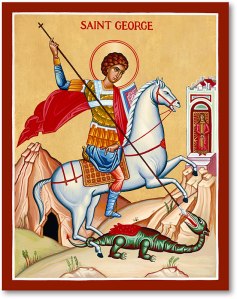 By the long road stands the garrison church, dedicated to our patron, Saint George. Above the porch the Saint is sculptured in stone, kneeling very humbly, as befits a gentle knight, beside the horrid monster that he has killed.
Non nobis, Domine, non nobis; sed Nomini Tuo da gloriam. So it is cut in Latin underneath the image of the Saint. Not unto us, O Lord, not unto us; but unto Thy Name give the praise. So let us give thanks when we, after the pattern of our Saint, have set our feet on the monster’s neck. It is is dangerous to be apocalyptic, and the interpretation of the prophecies has led, perhaps, to more frantic absurdities than any other pursuit open to mortals. But, reading the report of those things that have been done to women and children in Belgium, it seems to me that we need not hesitate in identifying the Dragon and the Beast of our age.
Wheel and march and turn and countermarch; all the while the work is going on. And all the while from some far-off camp there sings and rings a ceaseless bugle call. It is as though it were the call of the trumpet that England has put to her lips, that summons that shall sound and echo round all the regions of the world even till the hour of final victory.
Tuba mirum spargens sanum; wondrous sound the trumpet flingeth. It shall resound till it call up the spirits of the heroes to fight in the vanguard of our battle, till it summon King Arthur and all his chivalry forth from their magic sleep in Avalon; that they may strike one final shattering blow for the Isle of Britain against the heathen horde.
Previous: In Time of War
Next: The War Song of the Welsh
 darklybrightpress.com
A fascinating prologue indeed – many thanks! And thanks for the links – both texts are new to me! The English Wikipedia article, “Thomas Osbert Mordaunt”, notes “that at the Battle of Warburg on 31 July 1760 the squadron he served in was volleyed twice by a regiment of German grenadiers, and his commanding officer was killed. Taking command of the survivors, Mordaunt charged the Germans, capturing 300 men and two brass cannon. Duke Ferdinand of Brunswick-Wolfenbüttel described it as one of the ‘prodigies of valour’, and the captured cannon were displayed at the Tower of London.” I wonder if Machen knew that, and it contributed to his choice of the quotation? His German Wikipedia article shows us that the version of the text Machen quotes is that used by Sir Walter Scott in Old Mortality – and notes the poem’s appearance in the 12 October 1791 issue of James Anderson’s weekly, The Bee, with the description “A Poem, said to be written by Major Mordaunt during the last German War. Never before published.”
There seem to be lots of recordings of “A hundred pipers” on YouTube. I wonder if Machen thought of these lines when mentioning it?: “Will they a’ return to their ain dear glen? / Will they a’ return oor Heilan’ men? / Second sichted Sandy looked fu’ wae. / An’ mithers grat when they march’d away.”
For he makes a different fascinating use of the imagery of the Book of Daniel, chapter 3, and the “Benedicite” (taken up in the Book of Common Prayer) here than he does elsewhere: “I would say that all along that road great furnaces have been seven times heated. In those furnaces they are forging instruments wherewith to shape the world; they are making Englishmen into an English army.”
One can find versions of his two Latin musical references on YouTube as well – the “Non nobis” referred to in Shakespeare’s Henry V in the famous canon version taken up in the 1944 movie, for instance, and any number of versions of the “Tuba mirum spargens sonum” from the sequence, “Dies Irae”, from the Requiem Mass.
There seem to be a lot of Churches in Aldershot – the one Machen is referring to what is now (in the words of its Wikipedia article title) the “Cathedral of St Michael and St George, Aldershot” – which article includes a nice color photo “the Saint […] sculptured in stone, kneeling very humbly, as befits a gentle knight, beside the horrid monster that he has killed” – as well as a black-and-white photo of that space as yet sculptureless at the 7 October 1893 consecration of St. George’s Garrison Church.
LikeLike
Very tangentially, getting me acquainted with “The Call” and Thomas Osbert Mordaunt just got me to try Arthur Conan Doyle’s “One Crowded Hour”, first published in The Strand in August 1911 -which I thoroughly enjoyed. It includes “a Mauser pistol” – whether it includes German agents skulking about the Weald in the reign of King George V, would be telling too much…
LikeLike
Now you have me curious. I will need to add that Conan Doyle story to my reading list.
LikeLike
Thank you for hunting up these details! For the curious reader, I’ve added some links below:
https://www.youtube.com/results?search_query=A+hundred+pipers
https://en.wikipedia.org/wiki/Cathedral_of_St_Michael_and_St_George,_Aldershot
LikeLike
It is curious, finally catching up with The Hill of Dreams to in find in 1907 a well-developed trumpet and ancient solders ‘theme’ (complete with Latin quotation) launched in chapter two and taken up in chapter seven, in its way looking forward to so much to come.
LikeLike