
The Weekly Machen
You read the title of the post correctly: Arthur Machen takes the plunge. In an early article for the Evening News, he visits the Japanese-British Exhibition. (For more on this historical world fair, please refer to this excellent account.) Interestingly, Machen gives no space in his column for the many cultural exhibits. Rather he wonders and meditates on the strange effect of amusement rides upon ordinary British subjects. The text takes a delightfully pleasant Machenalian direction as our reporter considers the vital roles art and symbology play in the inner life of man.
The Craving to Scream:
A Musician’s “Wiggle-Woggle” Theory
by
Arthur Machen
June 22, 1910

The cushioned tubs, full of wogglers in a high state of pleasurable excitement, were slowly drawn up to the summit of the inclined plane and then impelled downward with a dexterous swirl.
The tubs veered to the right and were brought up by the barriers with a horrid bump, and the said bump impelled the strange cars to the left, from which they were jerked with a bang.
Then they seemed to swirl round and round like leaves in an eddy of fierce water; again they shot forward and progressed in a series of bumps and bangs and jerks and swirls to the bottom of the slide. Ladies’ hats fell off freely, total strangers were violently impelled against one another, the exertion of endeavouring to keep in one’s position tended to redden the face, shriek followed on shriek.
Such is the ceremony of the wigglers and the wogglers as it is to be seen at the Japan-British Exhibition.
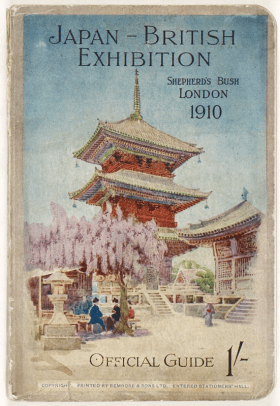 And I cannot read without a smile a paragraph in the official guide, referring I think, to the inhabitants of Formosa: “A visit to their quarters is an education in the manners and customs of this decidedly peculiar people.”
This “decidedly peculiar people”! It seems to me that there are other peoples besides the Formosans who may be styled “decidedly peculiar.”
The Joy of Discomfort
For the whole of the exhibition grounds teems with appliances for producing the acutest discomfort at a comparatively cheap rate.
There is not only the strange machine with the strange name that I have endeavoured to describe. There is “The Mountain Railway” in which the cars “descend by gravity at enormous speeds …. exceeding that of the fastest express trains anywhere in the world.” There is the Flip-flap, which gives you the sensation of “being suspended as if without support in mid-air.” There are the “Whirling Waters,” the “Spiral Railway,” and the “Submarine Railway,” which plunges you “into the turbulent waves,” and if you tire of these violent joys you can turn into the “Spider’s Web” and experience, in all its acuteness, the pleasure of losing your way completely.
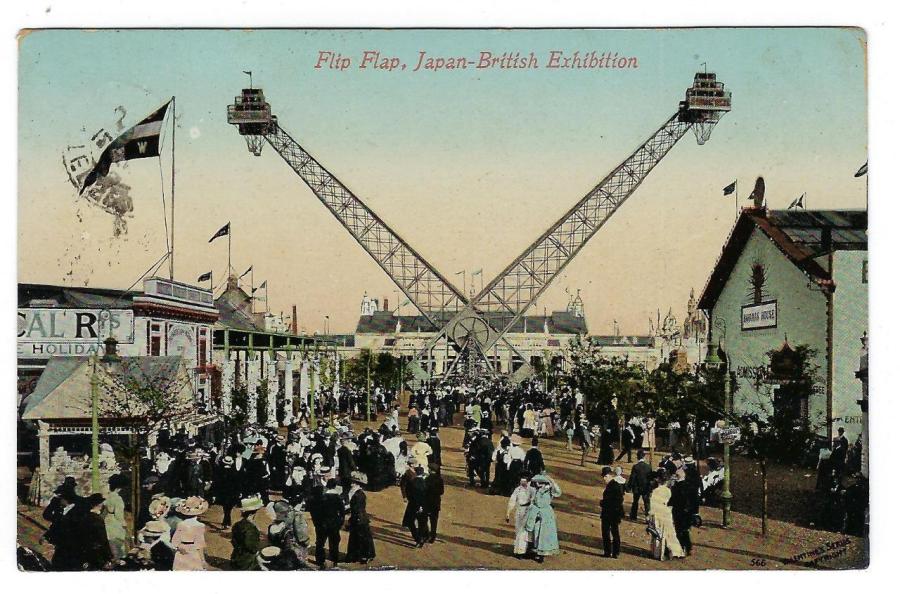
And the question is: Why do people play their sixpences by the hundred and the thousand in order to obtain sensations which in everyday life they would avoid with horror and disgust?
The ordinary human being does not like to be bumped or whirled or swirled or woggled or rapt through space at a hideous speed; he would do a great deal to shun the sensation of being suspended as if without support in mid-air.
Then why are all the contrivances named such tremendous successes? Why does the sixpences and the screams never fail?
A Musician’s Theory
“Well, a friend of mine, an eminent musician, accustomed to probe the psychology of noise to its depths, once offered me an interesting solution of the difficulty.
We had just rushed down the water-chute at Earl’s Court together—I have seldom experienced a more disagreeable sensation—and drew my attention to the screams and shrieks which rent the air as the boats swept down that horrible descent and struck the water with a sickening bang.
“This fact is,” said the musician, “that all girls want to scream. We don’t exactly know why this is so; most likely we are not meant to know; but there it is—they must scream, or they must—well, become politicians.
“Now the people who run these shows have meditated on this fact. They know that the girls want to scream, and they know that society frowns on the practice of screaming in the streets or at afternoon teas or whist drives. So they have invented the water-chute and the switchback and other things, simply in order that girls may scream and shriek freely and without reproach. All these dodges are simply excuses for screaming.”
The Love of Noise
Such was the musician’s theory, and I am inclined to think that there is a good deal to be said for it.
It cannot be denied that humanity, both male and female, loves in its heart to make a noise; and perhaps those Fugues of John Sebastien Bach that my friend used to play so exquisitely are but the last expression and transmutation of a primitive and universal instinct, for music, after all, is but a succession of beautiful noises. Every child loves a paint box, loves to practice the art of splashing white paper with blazing blues and shrieking greens and staring scarlets; hence, at last, Turner, all the wonder and beauty of the fine art of painting. Every child, given sand and a spade, will construct some kind of castle; hence at last the fine art of architecture.
And so, it must appear, music, that most spiritual of all the arts, draws its origin from the primitive yell.
And, of course, in spite of the existence of music, the desire of the noise which is purely inarticulate, still persists. Perhaps many of our wiggle-wogglers have a pretty taste in symphonies, and some skill in song; but the joy of the inarticulate still holds them, and as the modern world bans screaming under ordinary circumstances, they resort to the strange and discomforting machines at the exhibition, and howl without blame or censure to their heart’s content.
You find evidences of this odd passion for the inarticulate noise in all sorts of strange places; in the song of Roland, for example, sung by the minstrel at the Battle of Hastings, there occurs at intervals the word—though it is no word—“Aoi,” and “Aoi” is just a howl.
There are passions which are too obscure to be expressed in calm and logical propositions, or even in the strange music of rhyme and metre: hence “Aoi,” hence the shrieks of our wigglers and voyagers in submarine railways on whirling waters.
They do not really love the bumps and thumps and bangs and shocks that accompany most of these exercises; they find in these accidents the necessary excuse for yielding to a primitive passion.
There is no reason why people should like to howl? No; and there is no reason why people like to laugh or to sing or to dance.
And I should not wonder if it turned out that all the really natural things, all the desires which belong to man as man are equally devoid of “reason.”
Previous: An Irish Leader of Yesterday
Next: The Problem of Tom
 darklybrightpress.com
What an amazing column — I never would have expected Machen to write something like this when I was first reading him.
Naturally I kept thinking of the girls shrieking at the Beatles concerts. Maybe the desire to shriek helps to explain the popularity of stadium sports too.
I thought for a second also of shrieking in popular music, for example the “rebel yell” in the Pogues “If I Should Fall from Grace with God.”
On the other hand, back of Machen’s idea is an assumption about primitive man that doesn’t commend itself to me….
Dale Nelson
LikeLike
The Beatles sprang to my mind, too – and got me wondering whether this was a pre-Beatles phenomenon as well (I seem to remember a cartoon – Looney Tunes? – from the 1940s? – satirizing a young Frank Sinatra and audience response…). With reference to stadium sports, I remember a guest lecture I heard by William Bedell Stanford in 1979 or 1980 which, in passing, suggested a parallel between experience of, and behavior at, stadium sports and the catharsis of Greek tragedy! (In the context of recent Machen articles, I note he was born in 1910 in Belfast.)
This is an amazing article, and splendidly illustrated – and enriched by the excellent linked article. Maybe the extensive press coverage from well before it opened (chronicled in that article) inspired Machen to accent a novel feature distinctively different from the gardens and cultural exhibits.
I note that to the article’s items for Further Reading found in the Internet Archive may be added two scans of An illustrated catalogue of Japanese modern fine arts displayed there, and scans of The Gardeners’ Chronicle, Third Series, Volume XVII, January to June 1910, and volume XVIII, July to December 1910. Interestingly, 30 January was the 122nd anniversary of the signing of the first Anglo-Japanese Alliance – which (Wikipedia tells me) “was renewed and expanded in scope twice, in 1905 and 1911”. I wonder what popular-fiction reflections all this Anglo-Japanese attention may have had in that very Machen-y period? (Mr. Moto did not come along until 1935…)
LikeLike
Do we know enough about the performance of Greek tragedy to be sure the audience was quite like modern audiences, with people getting up from their seats after the performance ended and walking away peacefully discussing — ? I wonder — now! — whether they didn’t gasp, cry out, even scream e.g. when Oedipus appears, the eyes of the player’s mask “bloodied”? Maybe they were very noisy. But if they were how would we know? What do we know? ; )
LikeLike
Good questions – to which I do not know the answers, though ‘we’ might! I see W.B. Stanford has a book entitled Greek Tragedy and the Emotions: An Introductory Study, published a couple years after I heard him. He might well survey the written evidence. Eric Voegelin has an interesting take on Athenian tragedy in Order and History, Volume II, The World of the Polis, which was different from anything else I had read before – but it may be persuasive conjecture (I have not dug it out to try to check).
LikeLike
Or Dodds’s The Greeks and the Irrational?
LikeLike
Good thought! I’ve browsed it in a library a bit, enjoyably, years ago, but don’t remember any of the famous Dodds’s details! (By the way, no relation, that I know of: it’s apparently an English surname, but I’ve seen it on real estate signs in the marches of Wales – near Chester – and it seems to appear in Scotland as well as E.R. Dodds’s Northern Ireland.)
LikeLike