
The Hampdenshire Wonder by J. D. Beresford
Dale Nelson
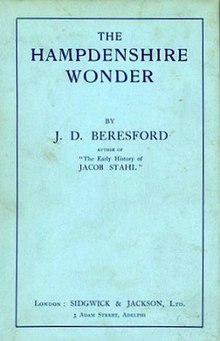 At least the title of The Hampdenshire Wonder (1911) is still remembered by readers especially interested in early science fiction. The short novel is obviously in the manner of H. G. Wells, combining a premise based on scientific speculation, a decidedly non-Christian view of the ultimate issues, and predictable social satire, set in cricket-playing rural England.
Living in a cottage in an obscure hamlet, the Wonder is Victor Stott, a child super-prodigy. As a baby he looks odd due to his large cranium and his uncanny brief stares, which suggest telepathic awareness of other people’s thoughts. As a little boy, he never has any interest in the practice of writing, and usually talks only as briefly as possible to get what he wants, being wholly free of affection and imagination. He is hated by the local clergyman, the Rev. Percy Crashaw, a rigid upholder of Church-sanctioned social order, who regards the child’s remarks as blasphemy. At seven and a half years, Victor’s bald head remains large for his body, which apparently prompts the village idiot – i.e. a young man with Down syndrome – to follow him around.
A local magnate with a library of many thousands of books allows the boy to read freely – although the little child must sit on a stack of books in order to look at volumes lying on the tabletop. Eventually the boy allows the magnate, Mr. Challis, to question him, and holds forth for six hours. The journalist narrator says a summary of Challis’s audience will be found at the book’s end, to which most readers probably will turn at once.
In the novel’s epilogue, then, Challis tells the journalist narrator what he remembers and what he thinks after hearing the Wonder – for once – hold forth. Challis doesn’t think it would do humanity any good to learn what he was told. “‘We are still mercifully surrounded with the countless mysteries’” that can make “‘human existence’” interesting. The prodigy’s grim understanding of reality would “‘resolve life into a disease of the ether… a demonstrable result of impeded force, to be evaluated by the application of an adequate formula.’” Rather than admit so dire a truth, we must have our mystics; we retain a “‘fierce need for the mystic to save us from the futility of a world we understand, to lie to us if need be, to inspirit our material and regular minds with some breath of delicious madness’” – otherwise, “‘the completeness of our knowledge will drive us at last to complete the dusty circle [i.e. to commit suicide as a species] in our eagerness to escape from a world we understand.’”
This is so close to the first paragraph of Lovecraft’s “The Call of Cthulhu” that one wonders if the Weird Tales author was, whether consciously or not, echoing Beresford’s rhetoric. As many readers of weird fantasy will recall, Lovecraft wrote, “The most merciful thing in the world, I think, is the inability of the human mind to correlate all its contents. We live on a placid island of ignorance in the midst of black seas of infinity, and it was not meant that we should voyage far. The sciences, each straining in its own direction, have hitherto harmed us little; but some day the piecing together of dissociated knowledge will open up such terrifying vistas of reality, and of our frightful position therein, that we shall either go mad from the revelation or flee from the deadly light into the peace and safety of a new dark age.”
Returning to the point in the novel at which the journalist-narrator had tipped us off about the summary at its end, we have the satirical matter of the village officials gathering to decide what to do about the five-year-old boy, since the law of the land is that he must be educated. Wells would have developed this situation’s potential for entertaining the reader, but Beresford does little with it.
When the prodigy is seven and a half years old, the reporter-narrator settles in the village and attempts to get to know the boy. In his sad awareness of ultimate truth, Victor has no interest in talking with him, but wants him to come along on his walks for fresh air, because the older man can scare away the “idiot.” Though he walks along with the boy, the narrator is sure that Victor Stott is “entirely alone among aliens who were unable to comprehend him.” The narrator regards Victor as “a very god among men. …I was powerless to disobey him. I feared him as I had once feared an imaginary God, but I did not hate him.” Wells would have dramatized Victor’s uncanny power rather more than Beresford does.
Then the boy goes missing. Eventually Victor’s body is found at the bottom of a pool, pressed into soft mud. The narrator suspects Crashaw of having killed him. So the story ends except for the epilogue mentioned above.
The novel’s play with popular evolutionism is signaled early on, in the leisurely account of Victor’s father, “Ginger” Stott. Ginger, whose father was a collier who died when Ginger was nine years old, lived a dull life till he suddenly took to cricket, at which he excelled so amazingly that first-time readers of the novel will think the Hampdenshire Wonder is a famous sports hero. I confess to skipping some passages impenetrable to me, ignorant of cricket terminology. Thanks to a cricket injury, Ginger’s finger has to be amputated, so he decides he wants to father a son and pass on his knowledge of the game. An unlovely 42-year-old spinster proposes to Ginger, the marriage is contracted, and the boy is begotten. That’s the origin story for Victor. His father finds he can’t bear to be around the baby and leaves.
Ginger’s wide chest, long arms, and reddish hair are probably meant to suggest evolutionary atavism. He’s a throwback, which makes his siring a precursor of Future Man particularly ironic.
In The Evening News for 24 July 1911 (Darkly Bright’s Weekly Machen feature 29 June 2023), Machen’s favorable review misstates Beresford. Machen sees the Wonder as being “about 1,000 years in intellectual advance of humanity,” while Challis says he is “‘many thousands of years ahead of us.’” Machen wrote, “the incident of the idiot’s instinctive sympathy for the Wonder tells the truth of the matter…: a being that was all knowledge and no imagination and no emotion would be an inhuman being, and with such a creature an imbecile would naturally consort, feeling the link of their common remoteness from sane humanity.” But this is Machen’s point, not Beresford’s. Remember, Beresford represents “mysticism” as delusion that protects humanity from the sad truth about the “futility” of existence.
Beresford fell into the same fallacy that H. G. Wells propounded in The War of the Worlds. The reporter-narrator writes of the depressing “thought of the insignificance of this little system that revolves round one of the lesser lights of the Milky Way.”
It’s easy to explode this notion, much-loved though it has been for over a century, by means of a simple thought experiment. Suppose this Earth of ours, and its sun and moon, were the only objects in a little universe, and these were all that existed. Probably Carl Sagan and Wells and all the rest would hesitate then to say that humanity was insignificant. Very well, let’s now add a few planets, so that we have a solar system: our sun and moon, this inhabited Earth, and Mercury, Venus, Mars, Jupiter, and Saturn as “stars.” Have the Earth and humanity now become insignificant? No? But surely Jupiter is quite big, after all — ? But if the solar system was all that existed in the physical universe, probably we would not say the bigness of the solar system over against our small planet and us proved that Earth and mankind are insignificant.
We may then go on to imagine a universe with one other star. Is this the magic point at which Earth and mankind are revealed as insignificant? No?
And so on. If “significance” has to do with bigness and littleness, then there must be some specifiable point at which the Earth and its inhabitants stop being significant. But the advocates of the familiar “insignificant Earth” cliché never tell us what that point is. They appear to be making a scientific statement, but it is nothing of the sort; it’s just rhetoric.
(The same point is true about the ancient-universe rhetoric. Formerly, many people believed the Earth and mankind were a few thousand years old. Eventually it was settled that the Earth is about 4.5 billion years old and the universe 13.7 billion years – till just yesterday as of the date of the drafting of this column, when, on 13 July 2023, it was announced that the universe is 26.7 billion years old. Well, that’s supposed to make people feel insignificant. But again, what’s the critical point in reasoning at which, when we arrive there, all smart people will agree we are “insignificant” because we are here but an instant compared to the age of the universe. The fact is that we are as significant now, with a universe 13.7 or 26.7 billion years old, as we were when the universe was reckoned to be a few thousand years old. “Significance” is a qualitative matter, and you can never get to accurate statements about qualities solely by reckoning quantities.)
 darklybrightpress.com
Thanks for this! It is striking how Machen seems to have flipped the unreliability of the narrator, and the unreliability of his witness, the magnate, to discern the inhumanity of (to apply a description of C.S. Lewis’s) ‘the child without a chest’ , remote from “sane humanity” – apparently in spite of the equal unreliability of Beresford as ‘thinker’ (!) – in order further to discern the propriety of the recognition of “mystery” and avoidance of reductionism. Having read this detailed review in addition to Machen’s, I wonder in how far the conclusion of his review preceding this one implicitly describes The Hampden Wonder, too: “The theorem of the mystic is that the soul, coming from God, can experience God, even in this life […]. The mystic says, ‘Thy will be done’; the magician, ‘My will be done.'” The shallow ‘savants’ of scientism, even apart from any bulldozing ‘applied science’, are asserting and attempting to effect their wills, unchecked by any reality which they cannot manipulate.
LikeLike