
The Weekly Machen
It is safe to say that Arthur Machen carried a good bit of skepticism concerning the books and subjects in the following article. As a staunch traditionalist, he saw little need for changing the language for economic reasons or for accepting the claims of new religious movements. As to the former subject, his comments below give a hint of the response he would have expressed toward the attenuated English practiced today in text messages. As for the latter, the fear of Mormonism’s spread was an established trope in literature and cinema of the period. The mentioned poetry books appear to be rather rare today.
Odd Volumes: The Language of the Future
by
Arthur Machen
August 2, 1911
For the last week or two we have all been thinking of aeroplanes and risking sunstrokes by gazing at their swift and threatening approach through the blue. We have been speculating, too, as to the future before these weird machines; wondering what changes they may bring about in the history of the world, and asking each other what the office and influence of the aeroplane may be in the next great war.
And on my shelf of odd volumes I have just found a little book which may revolutionise human speech as the aeroplane will doubtless revolutionise human locomotion. I see the coming of a new language which will be to our present utterance as the swiftest shorthand is to a child’s copybook text. Here is a specimen of the speech of the future:
Jexod—Finish as soon as possible.
Jexuf—Finished.
Jeyab—As soon as it is finished.
Jeyda—Not finished.
Jeyec—When will it be finished?
Jeyfe—Why was it not finished?
Jeygi—Finishing.
Jezfa—The fire is now completely extinguished.
Jezge—The fire is still raging.

Economy in Syllables
Now, as a matter of fact, this vocabulary is extracted from “Everybody’s Pocket Code” (Clowes), and it is meant to cheapen telegrams; but clearly a busy, hurrying and practical age must soon see that if one can say “Jezfa,” and be understood, it is a ridiculous waste of time to retain the cumbrous formula, “The fire is now completely extinguished.” Codish, as the new language will be called, says all this in two syllables; English requires ten; evidently English must go.
By an odd coincidence one week-end has brought me three little paper-bound volumes of verse. These are “Little Songs,” by Ella Erskine (Truslove and Hanson); “Poems, Twelve a Penny,” by D. L. Kelleher, presumably published by the author; and “Views in Verse of Hampstead’s Unappreciated Heath,” by “Grammaticus,” also published by the author.
Poems by the Dozen
The first of these booklets has eighteen pages, the second and the third twelve pages. Miss Erskine’s “Little Songs” are unpriced; Mr. Kelleher, as he says, sells his “Poems” at the rate of twelve a penny; and the metrical appreciations of “Grammaticus” cost threepence. Now, I am not going to criticise any of these poetical pamphlets—I only review verse under compulsion—but I want to say that I like the idea of publishing a small book and selling it for a small sum. There is gaiety about the plan which is singularly attractive; and one day, no doubt, a new theory of Beauty, Truth, or the Universe which has captured the world will be traced to some thin pamphlet, published at a penny.
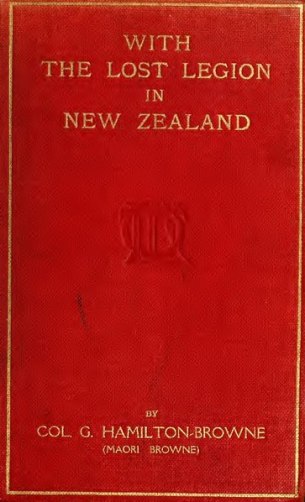 Who has heard of the Hau Hau faith, or the Pai Marire religion? The names are completely strange to me; and yet the doctrine denoted by these queer-looking words involved the colonists of New Zealand in a tedious and bloody warfare that lasted several years. The story of the Hau Haus is told with wonderful vivacity by Colonel G. Hamilton-Browne in “With the Lost Legion in New Zealand” (Laurie); and the excitement of the tale apart, I should think that the description of the way in which the Legion fought the Maoris in the bush must be of considerable military value.
The Angel’s Instructions
Pai Marire was invented by a Maori “natural,” or idiot, Te Ua, who said “that the archangel Michael, the angel Gabriel, and a host of minor spirits landed from the wrecked ship, Lord Worsley, and came to him.”
The angel instructed Te Ua to plant a pole a certain height in the ground, to be called Niu, around which all true believers were to worship and those found worthy were to be granted the gift of tongues, and also to be rendered invulnerable to the bullets of the white man.
And strangely enough this gibberish turned the Maoris who accepted it from chivalrous enemies into treacherous and bloodthirsty ruffians. Certain kinds of nonsense are sometimes very dangerous.
There has been a good deal of discussion lately about the Mormons and their missionary operations in England. So Mr. C. Sheridan Jones’s book, “The Mormons Unmasked” (Jarrold) is of topical interest. And it certainly tells the story of one of the oddest of all odd volumes—that is the “Book of Mormon.”
Salt Lake Scripture
This book, which is the sacred Scripture of Salt Lake City, was written by a young minister, Mr. Solomon Spaulding, who flourished c. 1809. It was a Biblical romance, and explained how the Red Indians were really degenerate descendants of Israelites, “who shortly before the Babylonian Captivity, marched across Arabia, and then contrived to cross the Atlantic.”
Spaulding called his book, “The Manuscript Found,” and sent it to a Pittsburg printer named Patterson. It was not published, and not returned to the author. Spaulding died, Patterson died, and the MS. fell into the hands of an ex-Baptist preacher named Rigdon. And Rigdon communicated “The Manuscript Found” to a personage named Joseph Smith.
Smith was an extraordinary man. He was a “Money Digger,” a person who professed to be able to discover buried treasure by occult art. Here the story touches on literature; it seems that the America of the early 19th century was possessed with the idea that hidden stores of gold were buried all over the continent. Plainly this notion was the theme on which Edgar Allan Poe built up the wonderful “Gold Bug,” the ancestor of many tales of dead pirates and concealed pieces-of-eight.
Insubstantial Emigrants
And I am interested to learn that Joe Smith, gold-digger and future prophet, undertook to find treasure by means of “a mystic stone, described as green with brown spots about the size of a goose’s egg.” I am interested by this fact, because it shows that to the wild America of ninety years ago there had passed over, somehow or other, very ancient traditions. That spotted stone used by Smith was a far-off descendant of the Hebrew Urim and Thummim, and it was a poor relation of the stone in our Coronation Chair; it was akin to the polished bones used by Highland seers; its humblest connection is, perhaps, the teacup with which the scrying Yorkshirewoman still peers in the back parlours of the back streets of Sheffield and Leeds.
Most likely Smith got his stone, or the notion of it, from some Highland emigrant; at any rate, with it and with the minister’s crazy romance he invented Mormonism, which is beginning to be recognised as a world-danger.
Previous: The Personal Element in Criticism
Next: Glimpses of Ireland
 darklybrightpress.com
What a fascinating article – thank you! Wikipedia tells me Catherine Winkworth (at 16) was actually responsible for Punch ‘reporting’ the supposed highly-economical 1844 telegraph message of military success from Sir Arthur Napier to Edward Law, First Earl Ellenborough when Governor General of India: “peccavi” (for ‘We have Sindh’) – but I was unaware of such books of Code (the Internet Archive link has several others under “Similar Items”!). Somewhat astonishing is Machen’s laconic reference to “the next great war”. I remember enjoying Byron Farwell’s Queen Victoria’s Little Wars (1972) when I was in school, and reading about – and sampling – popular fictional attention to possible future wars in Europe in the the late 19th- and early 20th-centuries, but do not remember ever encountering any expectations expressed in terms of “the next great war”. When was ‘the last great war’? – against Napoleon?
I see there is a later edition – or version – from 1920 of Charles Sheridan Jones’s book in the Internet Archive entitled The truth about the Mormons; secrets of Salt Lake City – and a lot of other possibly interesting-looking later books by him there too: Sun Yat Sen and the Awakening of China (1912), The unspeakable Prussian (October 1914),
The story of the Hohenzollern (1915), Bolshevism : its cause and cure [1919].
LikeLike
Alvin Schmidt’s book The American Muhammad may be recommended to those interested in early Mormonism, though the copy I was reading had too many errors that should have been caught in proofreading.
LikeLike