
Introduction
The following installment of Machen’s “Odd Volumes” is chock full of interesting parts which makes for a varied and satisfying whole. Among excerpts from the “world’s oldest book” and the writer’s amusing personal asides, we find Machen undercutting and dismissing the foundation of occult thought with a simple phrase. It does not matter that it falls within the context of reviewing a book by A. E Waite, one his oldest and closest friends. Those who tend to overemphasize the significance of Machen’s brief involvement in the occult should take note of such candid comments. Finally, Machen grants a glimpse into his feelings as a book reviewer, while adding a gloss on his long-standing literary theory of “hieroglyphics.”
Odd Volumes:
The Rare Gift of Literary Individuality
by
Arthur Machen
January 2, 1911
 For once in a way this column is to justify its name. The “odd volumes” are to be, for the most part, really odd.
To begin with, in the manner of John Wellington Wells, I propose to deal in magic and spells. Messers. Rider have just issued two curious books, “Ancient Mysteries and Modern Revelations,” by W. J. Colville, and “The Pictorial Key to the Tarot; being Fragments of a Secret Tradition Under the Veil of Divinations.”
This latter work is by Mr. Arthur Edward Waite, who is perhaps the greatest authority in the world on all things “occult.”
I may say at once that I soon fled from the contemplation of the “Ancient Mysteries.” Turning over the pages I saw the phrase: “The Great Pyramid of Egypt: Its Possible Use and Object.” This was enough for me.
Some people are made uneasy by the presence of a cat; there are many who shudder at King Charles’s head; there are many who do not wish to be informed that Bacon wrote Shakespeare, and that the world is flat.
I do not share all the aversions; I like all cats and am willing enough to discuss the Great Rebellion; I bar the Bacon business, and don’t care whether the world is flat or no.
But anything rather than that old occult scandal about the Pyramid!
Mr. Waite’s book stands on quite a different footing. I do not agree with him in his view that these old playing-cards conceal a secret tradition; I don’t believe that there is any such thing as a secret tradition.
Nevertheless, the problem of these most singular cards is a highly interesting one. We don’t know where they came from; they appear in Italy towards the close of the fourteenth century. From the East? It may be so, but this is a conjecture and nothing more.
Mr. Waite tells us all there is to be known about the Tarot pack, and the book is illustrated by seventy-eight plates; the Tarot has seventy-eight cards in it. These plates are the black and white version of the wonderful and imaginative coloured pack by Miss Pamela Colman Smith, who has made every card a picture card.
The next volume must be mentioned in the form of an announcement: on January 5, Mr. Eveleigh Nash will issue “Recollections of a Society Clairvoyant.” The book is anonymous, and that authority which used to be cited as “a little bird” tells me that there are some singular stories of contemporary life to be found in its pages. The little bird aforesaid—a literary magpie presumably—chatters of names indicated or concealed by initials and blanks: of “Mr. X.” and “Young B.”
This taste for scandals and gossip is a deplorable thing. Of course, Pepys and Grammont and Brantôme are very different; they are not scandalmongers, but valuable sources of historical information. Thus does time give grace and virtue to the naughtiest of men.
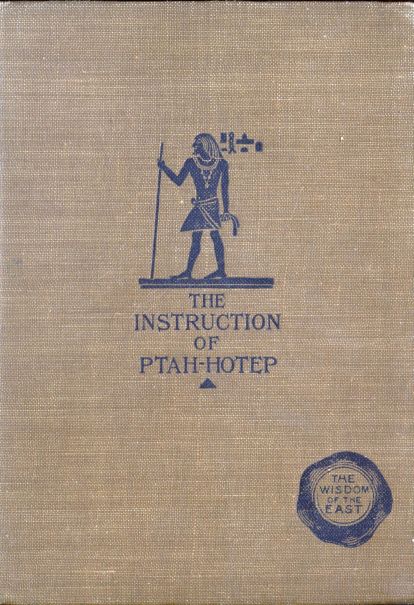
By an easy transition I pass from a book published next Thursday to a little work that was issued about 5,460 years ago. I do not know the name the name of the Egyptian firm which sent out the first copies of “The Instruction of Ptah-hotep,” but Mr. Murray is the publisher of the English version is the publisher of the English version by Mr. Bettiscombe Gunn. Ptah-hotep (the God Ptah is satisfied) lived, says Mr. Gunn, somewhere about 3550; he wrote thirteen centuries before Hammurabi, King of Babylon drafted his code of laws, two thousand years before Moses and Vedas, two-and-a-half thousand years before the days of Solomon who reigned in Jerusalem. The “Introduction” is the oldest book in the world. And the contents? Here are some samples of the author’s manner and matter:
If thou find an arguer talking, a poor man, that is to say not thine equal, be not scornful toward him because he is lowly . . . . it is shameful to confuse a mean mind.
If thou wouldst be a wise man, and one sitting in council with his overlord, apply thine heart unto perfection. Silence is more profitable unto thee than an abundance of speech.
He that is grasping in entertainment shall himself have an empty belly; he that causeth strife cometh himself to sorrow.
When favours have been shown unto servants, they say, “We go.”
A splendid thing is the obedience of an obedient son; he cometh in and listeneth obediently.
He that obeyeth becometh one obeyed.
The fool liveth in death . . . . it is his food.
It may be some comfort to the hurt and indignant housewife of to-day that 5,460 years ago in Egypt Jane, the cook, and Anne, the housemaid, loaded with favours, dowered with followers, and “evenings out,” said “We go.”
Looking back over the literary record of the year, I cannot help wishing that more “odd volumes” had appeared on the list.
Not odd, necessarily, in the sense of dealing with things occult; but odd as Hawthorne, and Poe, and Dickens are odd. For if one thinks of it, one sees that “singularity” can be predicted of every great literary masterpiece; the real book stands apart and alone, not to be confused with any of its fellows; it is an individual, because it is the the sincere expression of an individuality.
And one is sorry to say that this is the note which is lacking in nine-tenths—or ninety-nine hundredths—of contemporary “imaginative” literature. Novels, for the most part, are like to the race of sheep; one in like to another. Shepherds, they say, can see the difference between individuals; so that harmless drudge, the reviewer, is obliged to distinguish between the several volumes in the heavy pile before him.
But to the ordinary reader they are all dismally alike, and not one is alive.
The true writer of romances is necessarily an arrogant man, who has made up his mind that the public has got to read what he likes, not what it likes; he is to express himself, and the world has got to listen.
Such a one in making his literary testament should be able to say: “I have never written a single line with the intention of pleasing a single human being.” And the books of the man who could make that utterance would in all probability be permanent additions to the world’s treasure-house of delight.
The Weekly Machen
Previous: Looking Backward
Next: Unanimity Among the Conversationalists
 darklybrightpress.com
This was delightful – and, indeed, very interesting for “I don’t believe that there is any such thing as a secret tradition”.
I suspect “Grammont” is the ‘Duc’ who is the subject of Warren Lewis’s Assault on Olympus: The Rise of the House of Gramont 1604-78 (1958), and “Brantôme” is “Pierre de Bourdeille, seigneur de Brantôme” – in the title of his English Wikipedia article, which includes, with reference to his Memoirs, “There is not an homme illustre or a dame galante in all his gallery of portraits who has not engaged in sexual immorality; and yet the whole is narrated with the most complete unconsciousness that there is anything objectionable in their conduct”!
His last two paragraphs make me think of things Lewis and Tolkien say about writing things of the sort they like to read.
LikeLike
Here, and in many other places, Machen struck at the very root of occultism by rejecting its foundational premise. Thank you for the information on those obscure figures!
LikeLike
I’ve just read Charles Williams’s The Place of the Lion for the 6th time. Did Machen ever read it? Now there was an “odd” — and delightful and thought-provoking — novel.
LikeLike
Yes! We know that Machen read The Place of the Lion and The War in Heaven by Williams. It would be nice to now if he read any other CW’s novels or works by other Inklings.
LikeLike