
The Weekly Machen
This week, we step back to Machen’s earliest days at the Evening News. Only on the beat for a month, he was not yet a star reporter, but the following article, his third for the paper, gives us an idea of how he quickly gained that position. This is Arthur Machen in grand form. His sweeping prose carries a rhythm of a master storyteller. Still, after more than a century it remains potent as he is able to draw the reader deeply into an event with sincerity and skill.
The Shudders of the Drums:
London’s Splendid Pageant of Sorrow
by
Arthur Machen
May 21, 1910
The awful roll of drums!
The drum, musicians tell us, is at the very bottom of the scale of instruments. It is, they say, a savage thing; first cousin to the tom-toms of barbarous peoples, to the rude toys with which all primitive peoples gratify their love of noise as noise.
No doubt; and for all that there were little children among the mourning thousands yesterday who will remember in far off summers—when we have fallen asleep and rest in the stillness of the grave—the rolling of those awful drums that shuddered and reverberated as the mortal part of his late Majesty, King Edward the Seventh of Blessed Memory, was borne in funeral triumph through the shining streets.
The beating of the drum is barbarous? If so, then the kiss of the lover and the grip of the friend’s hand are barbarous; and again I say, those that heard the thunder of that final music will not forget.
In the dead of night, the heavens had pealed for the departed King. Thunder had echoed from the skies, and a torrent of rain had fallen on the dim, gathering multitude. Faint in the east a sad dawn slowly brightened, and then the sky cleared and the sun shone hot as I went out to take my place for the procession.
It was seven o’clock as I turned into Edgware-road, and I confess I was frightened at the sight before me. I was in no bodily fear of the crowd; I soon got to the stand at the corner of the Edgware-road and Oxford-terrace; and yet I was frightened. There something almost terrible in the sight of great masses of people all moved by one emotion; and I do not think that I have ever before received so vivid an impression of this awfulness of an assembled host.
Tiers of Solemn Black
It was not that the people in the streets below seethed as if the very earth had quickened and each grain of dust had become a man; it was not this wild and tumultuous confusion and struggle that struck me. The note of wonder was given not by those who tossed to and fro, but rather by those who sat still in their places, awfully arrayed. Tier upon tier of black clothes and white faces were set in order, rank upon rank of waiting people; and as far as one could see parapets and roof tops and widows were darkened with the mourners. Then came the hour for scaling the avenues of the procession; with curious skill the police shepherded the people in the streets to their place; and then the scarlet of the men-at-arms appeared, and the dark throng was edged with bright colour, and here and there the sun glittered on the cuirasses of the horse-soldiers.
The heat grew vehement, and the oppression of it soon began to have its effect on people packed tightly together, wearied, too, many of them by the long vigil of the night. Women turned white and sank down fainting; now an odd man, now a lad, would lean heavily upon his neighbours. The Ambulance Corps was ready; and it had willing assistance in the boy scouts and (quaintly and prettily attired, these latter) who darted in and out and gave first aid to the sufferers. Again and again, as the day grew on, I saw people borne away to the ambulance wagon; I do not think that this corner of Edgware-road was for a moment free of swooning men and women.
A Reverent Murmur
The air was heavy with the murmur and the rumour of thousands of voices. No one spoke aloud; but it was as though the great deep whispered and muttered on a far shore.
It was one of those occasions on which little things became great. The royal carriages that rolled by at intervals drew every eye towards them; plumed officers who galloped to and fro were gazed at eagerly as they spoke to other officers, indicating an order within an expressive wave of the hand. I do not think that my neighbours paid much attention to a group of three or four civilians who chatted together for a minute and then sauntered carelessly up and down the lines. I may be wrong, but I suppose that these quiet men in frock coats and tweeds, smoking their cigarettes, were by no means of small importance. They were watchful in their unobtrusive way, it seemed to me—and once remembered that there are even Englishmen who preach the horrible mania called Anarchy. I have read palliation—almost defence—of the hideous crime of Madrid on King Alfonso’s wedding day; and this in the work of a man of considerable position. Hence, I suppose, the presence of those quiet men with watchful eyes.
Message of the Gun
A sudden sound, dull and heavy and desolate, struck upon our ears; the first gun had been fired. We knew that with that distant thunder, the last pageant of King Edward had set out upon its way.
There came the fluttering of a gentle breeze, and, refreshed, we watched the tender green of the trees in the terrace stirring and glinting in sun and shade. And then there issued from the multitude a sound like a sigh. Looking down the Edgware-road, they had seen two flaring colors, gay and glancing, suddenly tremble, and slowly then sink to the ground. From rank to rank the word rang out, the arms of the men were lifted up, hung suspended in the air, and sorrowfully, slowly, sadly, they too sank, reversed, unto the ground. And the soldiers bowed their heads mournfully. And then, afar, through the long avenue of weeping, there advanced the dread pageant of death.
I cannot speak of it in detail. I cannot specify uniforms or distinguished straps, or count the regiments that advanced in that slow and serried and melancholy order. The scarlet and the gold, the array of silver and of black, the shining of steel, the reversed weapons, the mournful music and the throbbing echo of the drums, fused themselves together, for me, in a great symbol of majesty and death and prayer. I saw the leaders of the English people, our lords by sea and land, and lords from strange Eastern regions, and the Ambassadors of neighbour nations pass before me. India and Old Turkey, and territories of the Arabian nights were there, our fellow countries overseas—all the dominions of the world were met together.
Previous: How the King Was Crowned
Next: The Discovery of England


Thank you for this! “Grand form”, indeed! – including the subtlety of the second paragraph of the section headed “A Reverent Murmur”, “I suppose that these quiet men in frock coats and tweeds, smoking their cigarettes, were by no means of small importance” – for the fainting of two paragraphs earlier could easily enough have been succeeded by the slaughter of a terrorist attack. The example he cites was from ten days short of four years earlier. The Wikipedia article, “Morral Affair”, reports, “On May 31, 1906, Mateo Morral threw a bomb at King Alfonso XIII’s car as he returned with Victoria Eugenie from their wedding in Madrid. […] While the King and Queen emerged unscathed, 24 bystanders and soldiers were killed and over 100 more wounded. A British colonel observing the scene compared it to one of war.”
LikeLike
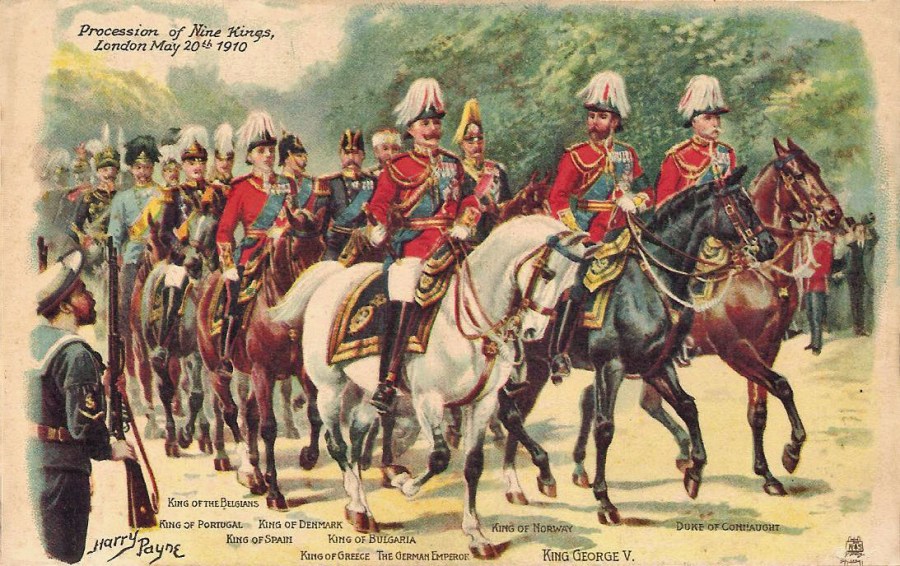
Belated thanks, too, for that fascinating Harry Payne illustration, “Procession of Nine Kings”! Perhaps Machen – and many an Evening News reader – were thoroughly familiar with them and their reigns, but I was not – though Machen’s reference to Alfonso’s near-assassination is clear. Having gone a-Wikipedia-ing, I find three were recently, and even briefly, King: Manuel of Portugal since 1 February 1908 until 5 October 1910; Frederick of Denmark since 29 January 1906 until his death in 1912; Ferdinand of Bulgaria more complicatedly as Prince since 1887, but as King only since 1908 until 1918 (though living on until 1948, through and beyond the reigns of his son and grandson); two others long since, but not for so much longer King: George of Greece since 30 March 1863 but for fewer than three years more, until 18 March 1913; Wilhelm since 1888, but hoping ever after his flight to the Netherlands in November 1918 for restoration; two recently beginning reigns of which one was a bit shorter than that of King George V – Albert of Belgium since 23 December 1909 until his death on 17 February 1934 – the other of which was quite a bit longer: Haakon of Norway since 18 November 1905 until 21 September 1957! Meanwhile, the Duke of Connaught, George’s uncle, Prince Arthur, had been Duke since the creation of that Dukedom on 24 May 1874 – and Earl of Sussex to boot from the same date – and would outlive his Royal Nephew by four days short of six years, dying on 16 January 1942 at 91!
LikeLike
And belated thanks to you for all this useful historical background! It makes wonderful addenda to the article.
LikeLike
Wikipedia ‘today in history’ for 16 October gave me two astonishing tangential new bits of context. First, some two-and-a-half-years after the “Morral Affair”, in 1909 “William Howard Taft and Porfirio Díaz hold the first summit between a U.S. and a Mexican president. They narrowly escape assassination”! Second, during the First Balkan War, in 1912 two Bulgarian army “aviators performed a reconnaissance flight over” the city of Adrianople / Edirne “in an Albatros F.2 biplane, also dropping two bombs. This was not only the first military mission performed by a Bulgarian aircraft, but also the first combat use of an aircraft in Europe and one of the first bombing attacks”! And a lot more early ‘aeroplane’ activity going on under King Ferdinand, making it understandable that 16 October is “Air Force Day” in Bulgaria…
LikeLike
Interesting! Thanks for sharing these obscure historical events.
LikeLike