
The Weekly Machen
Below, we find a slew of books mentioned by Arthur Machen, but he delves deeply into only a select few. Rarely did Machen mention politics in public, and the reader may easily discern his traditionalist and Unionist tendencies in reviews of the first two books, which both focused on Ireland. Though I personally appreciate A. C. Benson’s ghost stories, Machen’s critique of the writer’s therapeutic brand of feel-good books, which were quite popular, is sound and fair.
Books of the Week:
Glimpses of Ireland and Memories of Parnell
by
Arthur Machen
October 22, 1912

Mrs. Campbell Praed’s “Our Book of Memories” (Chatto and Windus) is worthy of a much longer notice than I can give it in this place.
It is a collection of letters written by Justin McCarthy to Mrs. Praed between the years 1865 and 1911, and there is hardly a paragraph that does not contain some interesting detail on the men who were making English history, English literature, and English art in a vivid and passionate period.
To most readers the political interest will be the chief one, and here the light thrown on the strange enigma of Parnell is exceptionally valuable.
Here, for example, is Mrs. Praed’s impression of Parnell seen at a dinner party:
The pale, refined face, with soft beard and mustache and particularly full, expressive eyes, which in the House of Commons had seemed to me almost saturnine, was now lighted by a kindly smile, and his great concern seemed to be that everyone should feel happy and at ease. His courtesy struck me as being of the old school—it was so very polished; and his soft voice and aristocratic bearing were as far removed as it is possible to imagine from the popular idea of the Irish agitator.
The Pathos of Politics
There is a pathetic note that runs all through the book; one cannot help regretting that Justin McCarthy suffered his heart to be rent, his mind to be distracted, and his bodily health to be broken down by the fierce squabbles of Irish Nationalism. Again and again the wretchedness of politics made Justin McCarthy wretched. Now he has to face the Unionist victory of 1860, now the Pigott forgeries vex him. These difficulties are overcome; Home Rule seems in sight; and then the news of the Parnell divorce is a thunderclap of consternation. Justin McCarthy felt that it was his duty to oppose his old leader, and suffers anguish in doing so. He is elected leader in Parnell’s place, and finds himself in command of a band more intent on quarrelling with one another than on facing the Unionist foe.
Justin McCarthy was scorched in these flames, and in his closing days it is evident that he recognised the pity of it all. Still, he felt that the cause of Nationalism called him, and he gave his life for what he conceived as the good of Ireland. This record of what he saw and felt and suffered behind the scenes of the long and painful drama will always remain an important and valuable guide to the secret political history of the ‘eighties and ‘nineties. Mrs. Campbell Praed has edited the correspondence and furnished the necessary connecting links with the utmost skill and discretion.
It is an old and sound observation that the popular writer is he who expresses that which most people have felt but have not uttered—even to themselves. We read some moral or psychological aphorism, and we say, “How true that is! And how odd that I should never have thought of it!” The fact is that I have often thought it, but vaguely, not clearly. And so to the reader of such things comes an oddly mingled joy of strangeness and familiarity; he sees an unknown face which yet appears an old friend.
The Irish question which tormented the days of Justin McCarthy is still with us in all its acuteness; and here is a book which I think all Unionists ought to read. “Rambles in Ireland” by Robert Lynd (Mills and Boon), is the work of an Irish Protestant and a strong Nationalist, a combination which is rare enough though Parnell was an illustrious example of it. Mr. Lynd writes throughout from a firm Nationalist standpoint, and it is good for us, who have no belief in the Home Rule panacea, to hear what a learned and humorous and clear-sighted Home Ruler has to say for his side of the dispute.
But, politics apart, “Rambles in Ireland” is full of observation and entertainment. It is a picture of modern Ireland in all its phases, sad and merry; and I must say that the chief impression one receives is that of disorder, of a people which has become almost a mob.
The author noted this want of organisation, and suffered from it on his rambles. He puts it down to the Norman invasion of 700 years ago. But we in England suffered from a Norman invasion 800 years ago—and brought order out of it.
Mr. A. C. Benson’s Ideals
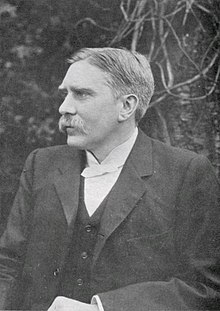 I should think that a good many people will enjoy “Thy Rod and Thy Staff” by Mr. A. C. Benson (Smith, Elder) in this way. Thus:—
The happiest times of life are the times when one has had congenial claims of duty, work, and love to satisfy and when one has never paused, as the full and eager days sped along, to wonder whether one is happy or to wish things different.
I don’t think that the thought of that passage is really original or valuable; but I feel sure that it will give pleasure to many readers.
I disagree with Mr. Benson in his account of Christian asceticism, which, he suggests, is the result of “the fastidious dislike of the gross claims of the body.” Such a state of mind is not Christian, but Manichean; it is based on the belief that the material universe and all that it contains are the work and kingdom of the devil. True asceticism is intensely practical; it may be defined as the abstinence from what is conceived to be a lesser good in order that something conceived to be a greater good may be enjoyed. Thus the ascetic man refuses cream cakes and curious sandwiches that he may keep a good appetite for his dinner.
I query, too, the statement that we should rather live by instinct than by reason. I am sure that there is a sense—and a very high sense—in which this is profoundly true; but there are so many kinds of instinct, and some of them are distinctly unpleasant.
Among other books on the shelf I note “The German Emperor and the Peace of the World” (Hodder and Stoughton). This book, by Alfred H. Fried, won the Nobel Peace Prize, and has a preface by Norman Angell. “Muddling Through” (Murray) is a novel by Lady Napier of Magdala. “In Jesuit Land,” by W. H. Koebel, has an introduction by Mr. Cunninghame Graham, who says that the rule of the missionaries made the country “as nearly an Arcadia as any place on earth.” Mr. Graham confesses that the Indians did not possess the vote; but, he acutely adds, “We who have had our minds purged to some measure, by experience, from cant, know that a man can vote and be a slave.”
Previous: The “Shadow” of Christmas in the Book World
Next:
 darklybrightpress.com
One of the many books read by C. S. Lewis or at least catalogued in his library after his death is A. C. Benson’s The Upton Letters.
https://www.gutenberg.org/files/4615/4615-h/4615-h.htm
A couple of CSL’s letters mention the book. My impression is that it is “letters” only in the sense that Lewis’s “letters to Malcolm” were letters.
LikeLike
Thanks for this addition to Machen’s article! I had forgotten Lewis’s ACB references. To the Collected Letters Vol. I Index!… The first is less than two years after this article, and quite positive. With an equally positive follow-up a week later about having “taken a course of A.C. Benson’s essays”. A year-and-a-half later, the former book seems a point of reference. A year after that, now to his friend, Arthur Greeves rather than his father, he says he’s read “5 or 6 […] I enjoyed them all very much, they are nice companionable reading for lonely men.” And, a couple weeks later, “The titles of Benson’s essays which you quote bring back memories of pleasant mornings over my tea in bed at home.” A month later, ACB’s younger brother E.F. comes into the picture with The Angel of Pain “which I give full marks”. It’s summarized at fadedpage “A man who returns to nature, lives in the woods, discovers that he can by mental sympathy call the birds to his hand, and enters into inexplicable intimacy with the forest creatures” – ! Nearly half-a-year later he is comparing ACB favorably to George Borrow. And eleven-and-a-half years after the first mention of The Upton Letters, it is still a vivid point of shared and valued reference in a 1926 letter to his father.
All of which makes me think I should try more ACB – I think the only thing in prose I know is from a recent browse in his memoir of his even younger (and young deceased) brother, Hugh. It’s interesting to compare Machen’s expectation of ACB pleasing and Lewis’s details. I have enjoyed as much EFB as I know (which is not very much) and RHB much more (of which I have read more, too). Some Margaret B sounds interesting, but I have not tried any, yet. If Machen is just in his objections about ACB on asceticism and instinct, I thoroughly agree. I don’t think I’ve tried any of the father, EWB’s works, either – and looking him up to check, am struck by Wikipedia reporting that Henry James’s “source for the novella The Turn of the Screw” was EWB!
LikeLike
I did not know that Lewis had read A. C. Benson. I have a casual interest in the Benson family: https://darklybrightpress.com/bensonia/.
LikeLike