
The Weekly Machen
Below, Arthur Machen finely sings the praises of English countrysides and Welsh villages. At a time when the British Empire covered the globe, he remained dedicated to the beauty and mysteries of the home islands. In this assignment, Machen’s words resonate with a core theme from his classic essay: “…I must say that anybody who as any difficulty in finding Dulwich a fit symbol of Paradise had better abandon the study of the secret language for ever.”
The following article is not listed in the bibliography by Goldstone and Sweetser.
The Discovery of England:
A Proper Appreciation of Three University Cities
by
Arthur Machen
July 20, 1912
People tell me that the North Pole has been discovered and that the South Pole has been discovered. It may be so; I neither know nor care; but I am pleased to think that there is every likelihood that the discovery of England will soon be an accomplished fact.
I have been looking over some handsome, well-conditioned and stately books that Messrs. Constable have sent me; four volumes from their new series of anthologies.
The books are “In Praise of Oxford” (2 vols.), by Messrs. Seccombe and Scott; “In Praise of Cambridge,” by Sydney Waterlow; and “In Praise of Edinburgh,” by Rosaline Masson.
They have been compiled with the greatest skill and the greatest industry; for each of them is a complete and classified “scrap-book” of the town to which it relates, bringing into its wide net historical learning and theories as to origin, and also the very latest gossip and an impression gathered from a novel published a year or two ago.
In the Oxford volumes, for instance, you can read how a Public Disputation was conducted before Queen Elizabeth, how Jowett snubbed his forward undergraduates, and how a Fellow, annoyed by the grass under his window being trampled down, set a mantrap and caught a Professor of Moral Philosophy in it, as late as 1860.
Nothing has been left out; from Chaucer’s Clerk of Oxenford and Mr. Verdant Green of l850 to the undergraduate of to-day. Every tale has been told, from the burning of Cranmer to the story of the Don who was called “Presence of Mind.” The Don in question was in a boating accident, and a man was trying to get into the boat. The Don explained that, having an umbrella, he had “the presence of mind” to rap the drowning man several times on the knuckles. He sank, and the boat was saved.
A Liberal Education
Well, all the volumes unite the grave and gay with equal success; but the point of this article is that at last we are discovering that we have towns at home as well worth writing about as are the towns abroad; that travel in England may be made as liberal an education as travel in France and Italy.
It has long been a tradition, not always openly expressed, but often merely implied, that Britain is an uninteresting place. The “Grand Tour” of the eighteenth century left out England, and Ruskin sent swarms of people to Venice, pouring scorn on our “vile Perpendicular” architecture—which is not vile by any means.
It is time that we began to make grand tours of England, to recognise that while Tours and Venice, Florence and Rome, are all admirable, we have good things at home; and that there is a peculiar grace and a distinction about old English towns which cannot be found elsewhere.
And it is a case of the remedy being near to the disease. Suppose you live in Hanley or in any of those terrible Five Towns which reek and smoke and burn with the pottery furnaces; where industrialism has blotted out all the paths of pleasantness.
Well, within an hour’s journey is Stafford, a place of such quiet and peace and ancient beauty that one instinctively looks for the cathedral that is not there.
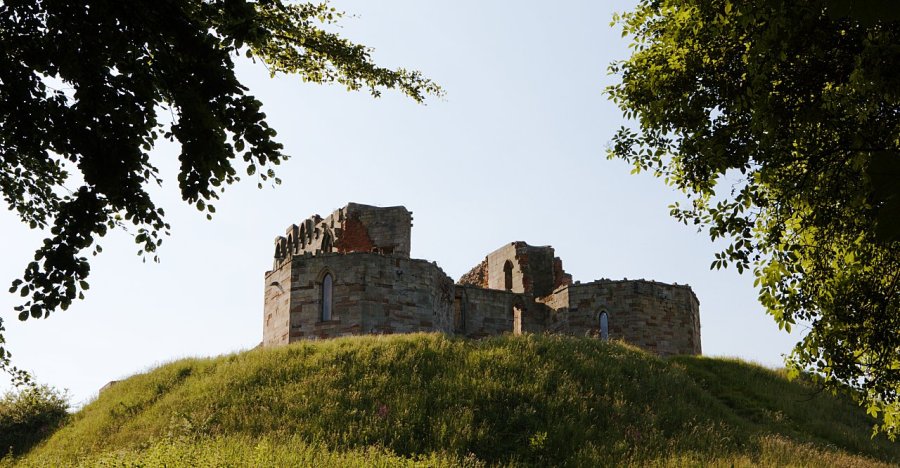
So the whirl and clatter of Birmingham and Wolverhampton have their antidote ready at Stratford-on-Avon; and the Glasgow man, weary of commerce—if Glasgow men are ever weary of commerce—can refresh his soul by the spectacle of Edinburgh, that is of one of the noblest and loveliest of all the cities of the world.
Some Suggestions
And there are lesser places, which might not furnish a Constable anthologist with materials for a thick volume, but are goodly and delicious for all that.
I can think of two or three in my own county of Monmouthshire. Newport is prosperous, but scarcely beautiful; and the hill districts in the northern part of the county which are represented in Parliament by Mr. McKenna, once beautiful, are now black with industry.
But Caerleon on Usk by the forest and the river is dim and magical with associations and relics of the Roman rule, and shines with the glow of the Arthurian Legend upon its mouldering walls. And the town of Usk itself is bowered amidst orchards and gardens, and Abergavenny is a town where every street ends in the prospect of a high mountain side, whence tracks wander off into slopes purple with heather, into wild regions of bracken and yellow gorse and waste heights of grey limestone rock.
Now, in spite of all facilities of travel, it is still something of an undertaking to go beyond seas. It will take the Birmingham man time to get to a forgotten town in Provence; he can leave clatter and clangour, smoke and bustle for an ancient calm and old carven beauty in that period which is known as “less than no time’’ if he will travel to Shropshire or Warwickshire or Gloucestershire. In the latter is Tewkesbury, a town with some of the finest and the richest half-timbered work in the Kingdom, a noble and storied minster, and traditions of a great battle in the Wars of the Roses. Here Mr, Pickwick, Mr. Ben Sawyer, Mr. Ben Allen, and Mr. Samuel Weller halted and drank strong ale and old Madeira; and the visit has been commemorated in a blue and gold tablet piously hung out by the “Hop Pole”; the inn chosen by this immortal company. Tewkesbury has only one fault for me; it is said to be the scene of a book called “John Halifax,” which I detest very heartily.
But clearly it is in the knowing of such places and the frequenting of their ancient and peaceful ways that we should seek medicine and palliation for the grind and roar and rush and blackness that has overwhelmed so much of England.
It is a far cry to Amboise on the Loire, Chinen by the Vienne. and Avignon, and Tarascon, and Arles on Rhone: but from the blackest, smokiest heart of black industrialism, there is always a ready and a quick path that will lead by clear, rushing streams, by deep valleys, by hills huge against the sunset sky, to our old towns, to the cities of refuge where we may implore peace and obtain it.
Previous: The Shudder of the Drums
Next: My Wandering Week, Part V
 darklybrightpress.com

What a splendid article! Including, what an intriguing series of books. Starting from your links, and going on via the author’s names, I see there are scans of both Oxford volumes, the Cambridge volume, and the Edinburgh volume in the Internet Archive. Oxford must have been the first, for opposite the title page it only lists the Oxford volumes of “Constable’s Anthologies” though adding “Other volumes to follow.” Edinburgh seems to have been next – followed apparently by Cambridge: then, Constable’s seemed to think in parallel with Machen’s broader suggestion of Wales – but only by going much further afield: In Praise of Australia and In Praise of Switzerland! And, in parallel with Machen’s suggestions of other worthy English towns, In Praise of Winchester – the last-named three also all scanned in the Internet Archive. Inconveniently, there is no series entry there for “Constable’s Anthologies”, so one must try filling in places after In Praise of and see what happens. No result for Tewkesbury, or of Gloucestershire, or for Caerleon or Monmouthshire. In 1926, A.G. (Arthur Granville) Bradley published In Praise of North Wales with Houghton Mifflin, but it is a travel book rather than an anthology (though it may be full of good anecdotes, etc.: clicking his name-link under its Internet Archive scan produced a voluminous and interesting-looking body of works including Other Days: Recollections of Rural England and Old Virginia, 1860-1880 from Constable in 1913! – and a Highways and Byways series).
Though I meet it here for the first, Machen’s well-expressed and heartening awareness of, and encouragement to visit, easily accessible smaller towns of beauty and interest throughout England and Wales, still applied in my experience in the 1970s and 1980s, and I hope it is still true today.
LikeLike
I agree with Machen about the Perpendicular style of English Gothic: “not vile at all”. Word-searching in the 1880 edition of Ruskin’s The Stones of Venice linked at its Wikipedia article, I find the intriguing sweeping summary (p. 23) “All the Gothics in existence, southern or northern, were corrupted at once: the German and French lost themselves in every species of extravagance; the English Gothic was confined, in its insanity, by a strait-waistcoat of perpendicular lines; the Italian effloresced on the mainland into the meaningless ornamentation of the Certosa of Pavia and the Cathedral of Como (a style sometimes ignorantly called Italian Gothic), and at Venice into the insipid confusion of the Porta della Carta and wild crockets of St. Mark’s” – ! The equally sweeping interpretation of the next sentence seems dubious (to put it with extreme mildness): “This corruption of all architecture, especially ecclesiastical, corresponded with, and marked the state of religion over all Europe”. It would be interesting to read a reaction to that in particular, by Machen.
But I am generally encouraged to think I should read more of what Ruskin wrote about the kinds of “Gothic” he liked, having happy memories of the excerpts in my undergraduate Victorian prose anthology! Wikipedia makes me think I should start with the 1855 Second Edition of The Seven Lamps of Architecture where he is quoted as saying “I have now no doubt that the only style proper for modern northern work, is the Northern Gothic of the thirteenth century, as exemplified, in England, pre-eminently by the cathedrals of Lincoln and Wells”.
John Halifax, Gentleman (1856) is among the many more or less famous Victorian novels I have not (yet?) read – in fact, I don’t think I’ve read anything by Dinah Maria Mulock (after 1865, Mrs. Craik). Now I’m curious about why Machen detested it “very heartily”! John Shaylor’s Introduction in the 1906 Everyman’s Library edition (as scanned in the Internet Archive) makes me the more curious.
LikeLike
I went looking to see what works of Dinah Maria Mulock Craik were at LibriVox, and have now enjoyed Miss Mulock’s short ghost story, “The Last House in C- Street”, originally published in a magazine (I have not traced which – possibilities include Dickens’s Household Words, mentioned among the sources in the general note) and published in “revised and extended” form in volume II of Nothing New: Tales (1857) (though the LibriVox link is to an 1874 American reprint) – as read by Anne Erickson. Now, of course, I wonder what Machen (might have) thought of it. He may have said something about it, somewhere, but if he is not (yet?) known to have, fellow enjoyers of his work may be interested to see what they think of this ‘true ghost story’ style tale.
LikeLike
Thnaks for this tip! I am unfamiliar with her work, but as a ghost story enthusiast I am deeply interested. I’ll will certainly report back after I listen to that recording.
LikeLike
An attractive feature of the story (and one which might have appealed to Machen) are the details of its situation in the London of the late 18th- or very early 19th-century – some Wikipedia searching suggests 1800, when John Kemble and Joseph Grimaldi acted together in a production of Hamlet at Drury Lane, as several people in the story go to see such a production.
LikeLike
David Llewellyn Dodds writes:
By the way:
(1) I see there is a 9 September guest post at Wormwoodiana about “Volume IV of the British Road Book, covering the West Midlands and Wales and published by the Cyclists’ Touring Club in a new edition in 1931” and a cycling novel by H.G. Wells (with commenters noting others) – but I cannot figure out how to discover if there is a scan of that Volume IV in the Internet Archive in any old or new edition (or perhaps I have merely discovered that there is no such scan there – ?);
(2) it is intriguing to think, looking up the answer to “People tell me that the North Pole has been discovered and that the South Pole has been discovered. It may be so” – that, at least as far as the North Pole (and Wikipedia), apparently both the “US explorer Frederick Cook claimed to have reached the North Pole on 21 April 1908 with two Inuit men, Ahwelah and Etukishook, but he was unable to produce convincing proof and his claim is not widely accepted” and “Robert Peary […] claimed to have reached the Pole on 6 April 1909, accompanied by Matthew Henson and four Inuit men, Ootah, Seeglo, Egingwah, and Ooqueah. However, Peary’s claim remains highly disputed and controversial” -though widely accepted at the time (note the 13 October 1909 Puck magazine cover cartoon)!
With respect to the South Pole (and, again, Wikipedia), there seems less controversy: “The first men to reach the Geographic South Pole were the Norwegian Roald Amundsen and his party on 14 December 1911” though this was not reported at all until 7 March 1912 with him cabling “the first full account of the story to London’s Daily Chronicle, to which he had sold exclusive rights” on 8 March. Meanwhile, Robert Falcon Scott had “returned to Antarctica with his second expedition, the Terra Nova Expedition, initially unaware of Amundsen’s secretive expedition. Scott and four other men reached the South Pole on 17 January 1912, thirty-four days after Amundsen. On the return trip, Scott and his four companions all died of starvation and extreme cold” – though there was no news of Scott when Admundsen cabled his report, and the “bodies of Scott and his companions were discovered by a search party on 12 November 1912 and their records retrieved” – so Machen was apparently writing this in the midst of something very much a current and mysterious matter, and his saying “I neither know nor care” had nothing callous about it, with respect to the South Pole and Scott’s expedition (though it would be interesting to know what – if any – apprehensiveness there might have been in June 1912).
LikeLike
Now I’ve enjoyed Mrs. Craik’s The Adventures of a Brownie as Told to my Child (1872) – written for their adopted daughter, Dorothy, and much reprinted. I wonder what folklore sources she may have drawn upon? (How ignorant I am of such things!) It has things that remind me of Tolkien – but that may just mean he was not ignorant of folklore and -tales!
LikeLike
Just noticed the scan entitled “The Illustrated London News 1912-05-18: Vol 140 Iss 3813” in the Internet Archive has “Photographs of the Discovery of the South Pole”!
LikeLike
It suddenly occurred to me with respect to the North Pole that it would be another eight years before the first-born of the Tolkien children would receive the first letter from Father Nicholas Christmas sent from there. With apologies if the answers are obvious and abundant, as I have not paused to attempt my ‘Machen homework’, do we know what-all attention (if any to speak of) Machen paid to the traditional (and developed ‘literary’ and ‘commercial’) lore of both St. Nicholas and Father Christmas?
LikeLike